
TL;DR:
- The legal status of CBD in the US is complex and evolving, especially with upcoming 2026 regulations.
- Federal law permits hemp-derived CBD containing no more than 0.3% delta-9 THC, but regulations on product THC limits are changing.
- Despite widespread availability, CBD’s health benefits are supported mainly by strong evidence for epilepsy, with other uses still under research.
CBD products are everywhere — stocked on pharmacy shelves, sold in gas stations, and promoted across social media as the new frontier of wellness. Yet the legal reality behind every bottle and gummy is far more tangled than most sellers will tell you. Federal law changed dramatically in 2018, but what counts as “legal” CBD has continued to shift, and 2026 is bringing another round of rule changes that could make some of today’s bestsellers suddenly illegal. If you’re using CBD for relaxation, sleep, or general wellness, understanding exactly where the law stands right now is not optional — it’s essential.
Table of Contents
- How did CBD become legal in the U.S.?
- Key legal boundaries: What actually makes CBD legal or illegal
- Federal loopholes and the FDA: The rules aren’t what you think
- State laws and the future: Where U.S. CBD legality is headed in 2026
- CBD for wellness: What science really says about benefits and risks
- Why CBD legality is more complex (and changing faster) than most realize
- Get safe, legal CBD delivered with Get Blazy
- Frequently asked questions
Key Takeaways
| Point | Details |
|---|---|
| 2018 Farm Bill changed federal law | CBD from hemp is federally legal if it contains less than 0.3% THC, but only under strict conditions. |
| FDA and state rules create confusion | FDA prohibits most CBD in foods and supplements; states have their own CBD regulations on top of federal law. |
| 2026 THC limits could criminalize some products | A new federal law will institute a hard cap on total THC per container, impacting many full-spectrum CBD products. |
| Wellness claims have limited scientific support | CBD is best established for rare epilepsy and anxiety; evidence for pain and relaxation is weak and safety is still being studied. |
| Legal status keeps changing | CBD laws are evolving quickly, so always check current federal and state rules before purchasing. |
How did CBD become legal in the U.S.?
For decades, CBD was treated the same as marijuana under federal law. It didn’t matter that CBD has no intoxicating effects. If it came from the cannabis plant, it was a controlled substance. That changed dramatically in December 2018.
The Agriculture Improvement Act of 2018 — commonly called the Farm Bill — removed hemp from the federal definition of marijuana under the Controlled Substances Act (CSA). The key rule: CBD is federally legal only when it comes from hemp, defined as cannabis containing no more than 0.3% delta-9 THC by dry weight. Any cannabis plant above that threshold is still classified as marijuana and remains a Schedule I controlled substance.
This distinction is not just technical. It’s the entire legal foundation for the U.S. CBD market. Here’s how the shift unfolded:
- Before 2018, the DEA treated all cannabis extracts, including CBD, as Schedule I drugs with no accepted medical use.
- The 2018 Farm Bill explicitly excluded hemp and hemp-derived cannabinoids from the CSA’s definition of marijuana.
- This opened the door for farmers to legally grow hemp and for companies to sell hemp-derived CBD products across state lines.
- The FDA was given authority to regulate CBD in food and drug products, creating a separate layer of restrictions that still causes confusion today.
“The single biggest misconception people have is thinking federal legalization means anything goes. The 2018 Farm Bill created a legal path, not a free pass.”
Even with the Farm Bill in place, federal legalization doesn’t eliminate every obstacle. States retained the right to set their own rules, and the FDA retained oversight over health claims and food safety. That combination is why you can walk into a store in one state and find shelves loaded with CBD products, then cross into a neighboring state and find almost nothing.
Key legal boundaries: What actually makes CBD legal or illegal
Having covered how the Farm Bill created a legal path for CBD, let’s break down where current law draws the lines — what separates legal from illegal CBD?
The basic rule is simple: if a product meets the hemp definition and contains no more than 0.3% delta-9 THC, it’s federally legal. But the details get complicated fast.
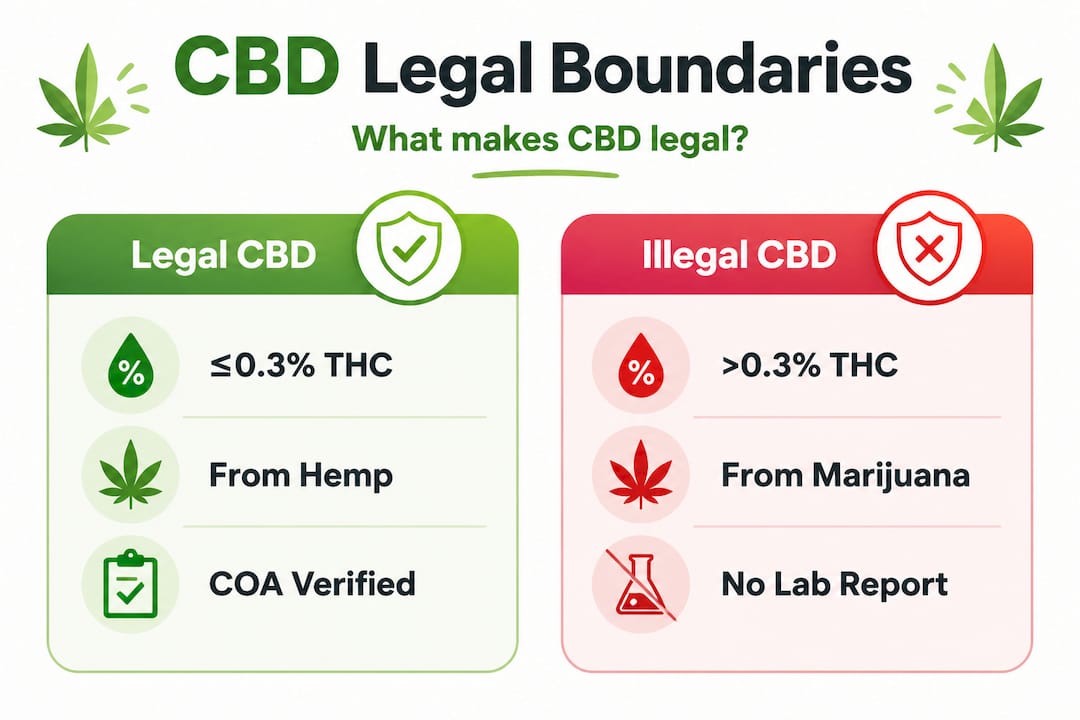
| Factor | Legal threshold | Notes |
|---|---|---|
| Delta-9 THC percentage | ≤0.3% dry weight | Based on hemp definition under Farm Bill |
| Total THC per container (after Nov 2026) | ≤0.4mg per container | New limit under 2025 Continuing Resolution |
| Product type | Topicals, oils, vapes | Foods and dietary supplements restricted by FDA |
| State law | Varies widely | May be stricter than federal standards |
The biggest regulatory shift happening right now involves total THC limits. The 2025 Continuing Resolution, effective November 12, 2026, redefines hemp not just by percentage but by total THC content, capping it at 0.4mg total THC per container. This is a major change. Many full-spectrum CBD products currently on shelves could exceed that threshold and be reclassified as Schedule I controlled substances — not because they’re intoxicating, but because the cumulative THC in the bottle crosses the new limit.
On top of that, the FDA’s position creates a second set of restrictions entirely. According to recent federal guidance, hemp-derived CBD products may meet the CSA’s hemp definition while still being prohibited by the FDA for use in foods or dietary supplements. The reason: because CBD was studied as a pharmaceutical drug (Epidiolex, approved for epilepsy in 2018), the FDA’s drug preclusion rule bars it from also being sold as a supplement.
Here’s what that means in practical terms:
- CBD tinctures labeled as “wellness supplements” may be violating FDA rules even if they’re hemp-compliant.
- CBD-infused beverages or edibles marketed for health purposes are in a legal gray zone at the federal level.
- Topical CBD products like creams and salves face less scrutiny because they aren’t ingested.
- Products sold online that cross state lines are subject to federal law, meaning an illegal-in-one-state product can create shipping risks.
Pro Tip: Always look for a Certificate of Analysis (COA) from a third-party lab before buying any CBD product. A COA shows the actual cannabinoid content, not just what the label claims, which is critical for staying within legal limits.
Federal loopholes and the FDA: The rules aren’t what you think
Knowing the technical lines, you might wonder why so many products are on shelves — this is where federal gray areas come in.
The FDA has enforcement authority over CBD in foods and dietary supplements, but enforcement has been inconsistent for years. Thousands of CBD products technically violate FDA marketing rules, yet they sit on store shelves across the country. The reason is simple: the FDA has limited resources and has focused mainly on companies making egregious health claims, like products marketed to treat cancer or replace prescription drugs.
“The CBD market grew faster than the regulatory framework could keep up with. What you see on shelves is a snapshot of enforcement priorities, not full legal compliance.”
This gray market reality affects everyone who buys CBD. Products that look legal and are sold openly may still be operating outside FDA guidelines. The nuance matters because it affects liability, labeling accuracy, and what you’re actually consuming.
The FDA’s most current formal action was enforcement discretion for hemp-derived CBD dietary supplements, but this was limited to a specific context: a CMS Medicare pilot program, for patients under physician direction, announced in April 2026. This is not a blanket green light for CBD supplements sold over the counter. It’s a narrow exception.
What does this mean for everyday consumers?
- Products sold in retail stores as dietary supplements are in regulatory limbo at the federal level.
- Buying CBD online across state lines carries federal shipping considerations that sellers rarely disclose.
- Labeling claims like “supports calm” or “promotes recovery” walk a thin legal line under FDA rules on health claims.
- The best-positioned CBD products legally are those marketed as general wellness products without specific therapeutic claims, and sold as topicals or aromatherapy goods.
Pro Tip: If a CBD company makes specific claims like “treats anxiety” or “cures pain,” that’s a red flag for both legal compliance and product quality. Responsible companies use careful language and provide third-party testing results.
State laws and the future: Where U.S. CBD legality is headed in 2026
While federal law draws the big picture, states set their own rules — and that picture is about to shift again.
State-level CBD regulations vary dramatically. Some states have embraced hemp-derived CBD with minimal additional restrictions. Others require specific licensing for retailers, limit allowable THC content below the federal threshold, or prohibit CBD in food products entirely. A handful of states still treat certain CBD products with a level of scrutiny that approaches the old pre-2018 approach.
| State category | Examples | Key restrictions |
|---|---|---|
| Permissive states | Florida, Colorado, Oregon | CBD widely sold; few additional limits |
| Moderate states | Texas, Georgia, Illinois | Some restrictions on forms or health claims |
| Restrictive states | Idaho, Iowa (historically) | Stricter THC limits or food bans |
The 2026 federal changes add another layer of complexity. Full-spectrum CBD products, which contain trace amounts of THC alongside CBD and other cannabinoids, are especially at risk. As noted in current industry tracking, full-spectrum products with even small amounts of THC may exceed the new 0.4mg per container limit after November 2026, effectively making them illegal under federal law despite being non-intoxicating.
Key things to watch for when shopping:
- Broad-spectrum vs. full-spectrum labels. Broad-spectrum products have THC removed, making them less likely to exceed the new total THC limit. Full-spectrum products retain trace THC.
- Lab results date. Regulations change, and a COA from 2023 may not reflect current legal thresholds.
- State-specific labeling. Some states require specific warning labels or licensed dispensary sales.
- Online retailer location. A retailer based in a permissive state may ship a product that’s restricted where you live.
An estimated 20 to 35% of U.S. adults report using CBD for wellness purposes, which means millions of people are navigating this patchwork of laws — often without realizing the risks.
CBD for wellness: What science really says about benefits and risks
Legal or not, many people use CBD hoping for health benefits — so what does the science actually say?
The honest answer is that the evidence is mixed, and much of the popular belief about CBD’s health benefits runs well ahead of what research has actually proven.
The strongest case for CBD is in seizure disorders. Epidiolex, an FDA-approved CBD-based drug, has robust clinical evidence supporting its use in two rare forms of epilepsy. That’s the gold standard of CBD research.
For everything else, the picture is murkier. According to FDA investigators, CBD shows preliminary evidence for anxiety reduction in small randomized controlled trials, with a large effect size in those limited studies. However, the current body of evidence is insufficient to make firm recommendations for pain, insomnia, or general relaxation in adults.
Research published in JAMA adds important safety context. About 5.6% of people taking CBD at consumer-level doses experienced elevated liver enzymes — a sign of potential liver stress. CBD also interacts with several common medications, particularly blood thinners like warfarin, by affecting the same liver enzymes that process those drugs.
What the science supports:
- Epilepsy (specific conditions): Strong, FDA-validated evidence
- Anxiety: Promising early data, but small study sizes limit conclusions
- Pain: Low-quality evidence; surveys show use, but clinical trials are weak
- Sleep: Insufficient evidence; short-term studies show mixed results
“Many adults use CBD and report feeling better. That’s real — but it’s not the same as clinical proof. The placebo effect is powerful, and CBD’s legal complexity makes it hard to study properly.”
Risks to take seriously:
- Liver enzyme elevation at consumer doses
- Drug interactions, particularly with blood thinners and anti-seizure medications
- Product mislabeling due to lack of strict oversight
- Possible contamination from poorly manufactured products
Pro Tip: If you take any prescription medication, talk to a pharmacist or doctor before starting CBD. The interaction risk is real and often overlooked in wellness marketing.
Why CBD legality is more complex (and changing faster) than most realize
Here’s something most CBD guides won’t say plainly: a lot of the “expert” advice you read online is already out of date. Laws changed in 2018. Then again with FDA guidance. And now the 2026 Continuing Resolution is rewriting the rules yet again. An article written in 2023 about CBD legality may be giving you a false sense of confidence.
The people who get burned are the ones who do a quick search, see “hemp CBD is legal,” and stop there. They don’t realize that “legal” has four or five layers: federal statute, FDA regulation, state law, local ordinance, and soon the new THC-per-container rule. Full-spectrum CBD — the type many people prefer because of the “entourage effect” from trace cannabinoids — is sitting in the crosshairs of the 2026 changes. If you’re buying that type of product right now, you need to know the window may be closing.
The practical wisdom is straightforward: check the law at the time you’re buying, not at the time you learned about it. Look for products from companies that update their COAs to reflect current legal standards, not just the standards that existed when they launched. And understand that state-to-state shipping of CBD is not a guaranteed right — it’s a legal risk you’re taking based on the laws of two jurisdictions simultaneously.
The CBD industry is still maturing. That means real opportunities to find genuinely helpful products, but also real risks if you shop without paying attention to the evolving legal landscape.
Get safe, legal CBD delivered with Get Blazy
If keeping up with all these legal changes sounds exhausting, that’s exactly why sourcing from a trusted retailer matters. Get Blazy CBD Dispensary, located on Biscayne Blvd in Miami, carries premium hemp-derived products that are lab-tested for both purity and legal compliance with current federal and Florida standards.
Whether you’re looking for CBD oils, gummies, vape cartridges, or topicals, every product at Get Blazy is sourced from reputable manufacturers and verified through third-party testing. You can shop in-store or take advantage of legal CBD delivery across Miami for fast and discreet service. As laws evolve, Get Blazy stays current — so you don’t have to navigate those changes alone. Visit us online or in person, and shop with confidence.
Frequently asked questions
Is CBD oil legal in every U.S. state?
No. While federally compliant hemp-derived CBD oil is legal in most states, state-level restrictions vary significantly — some impose stricter THC limits or ban certain product forms entirely.
Can I buy CBD edibles or gummies legally?
CBD edibles exist in a gray zone: the FDA prohibits marketing CBD in foods or dietary supplements at the federal level, though some states permit them if made from compliant hemp within local THC limits.
Will the 2026 law changes make some CBD illegal?
Yes. The 2025 Continuing Resolution effective November 2026 sets a cap of 0.4mg total THC per container, meaning products that exceed this — including many full-spectrum CBD items — could be reclassified as Schedule I substances.
Is CBD safe for daily use?
CBD is generally well-tolerated, but FDA safety research shows liver enzyme elevation in a portion of users and potential drug interactions; always consult a doctor before using CBD regularly alongside prescription medications.
Can you travel with CBD products across state lines?
Traveling with federally compliant hemp-derived CBD is generally permitted, but state-specific rules at your departure and arrival points can vary enough that checking both before you travel is strongly recommended.