
TL;DR:
- Up to 95% of current CBD products may become illegal after 2026 due to new THC compliance rules.
- The shift to a total THC standard, including cannabinoids like THCA, will impact full-spectrum and certain products.
- Comprehensive testing, proper licensing, and adaptable systems are essential for long-term CBD business compliance.
Up to 90-95% of current CBD products are expected to fall out of legal compliance after the 2026 rule change, and most business owners have no idea it’s coming. The regulatory picture for hemp-derived CBD has always been messy, but a new federal law is about to redraw the lines entirely. Between overlapping FDA rules, state-by-state patchwork, and a complete redefinition of what counts as “hemp,” staying legal now requires a real strategy. This guide breaks down exactly what’s changing, what compliance looks like in practice, and what you need to do before the deadline hits.
Table of Contents
- What makes CBD compliance so complicated?
- Understanding the 2026 total THC rule
- Core compliance requirements for your CBD business
- Navigating FDA, state, and carrier restrictions
- Why real CBD compliance means building for disruption, not certainty
- How Get Blazy can help you navigate CBD compliance
- Frequently asked questions
Key Takeaways
| Point | Details |
|---|---|
| 2026 THC limits | Federal law will count all THC analogs, making many current CBD products non-compliant. |
| Core compliance steps | Get batch COAs, follow cGMP, test for contaminants, and verify age for each sale. |
| Patchwork state rules | Federal compliance alone is not enough; check state laws and shipping restrictions. |
| FDA enforcement | FDA bans CBD in food and supplements and enforces rules on claims and packaging. |
| Winning approaches | Smart businesses treat compliance as strategy—reformulate, segment markets, and document every step. |
What makes CBD compliance so complicated?
The confusion starts at the top. Hemp-derived CBD is federally legal if it contains ≤0.3% delta-9 THC by dry weight, but that single rule barely scratches the surface of what you need to know. The FDA adds another layer entirely: even if your product is perfectly legal under the Farm Bill, you still cannot add CBD to foods, beverages, or dietary supplements. That eliminates a massive portion of the current market right there.
Then come the states. Some states allow CBD edibles freely. Others ban them outright. A few require specific licenses just to sell topicals. There is no single rulebook, and what works in Florida may get your shipment seized in another state. Businesses trip up constantly on issues that seem minor until they become a legal problem:
- Age verification: Many states require age gates online and ID checks in-store, but the minimum age varies.
- Child-resistant packaging: Required in most states for ingestibles, but enforcement is inconsistent.
- Health claims: Saying your CBD “treats anxiety” or “cures pain” is an FDA violation, full stop.
- Labeling accuracy: Mislabeled THC content is one of the most common enforcement triggers.
Now add the biggest disruption yet. A major 2025 Continuing Resolution will fundamentally redefine hemp for compliance purposes starting in 2026. The old delta-9-only threshold is being replaced with a total THC calculation that includes previously unregulated cannabinoids. The industry is already sounding the alarm.
“An estimated 90-95% of current CBD products on the market will be illegal after the 2026 rule change takes effect.”
For businesses operating on the weed delivery marketplace or selling through retail, this is not a distant concern. It is an immediate operational issue. And the FDA enforcement policies around ingestibles are tightening in parallel, making 2026 a genuine turning point for the entire sector.
Understanding the 2026 total THC rule
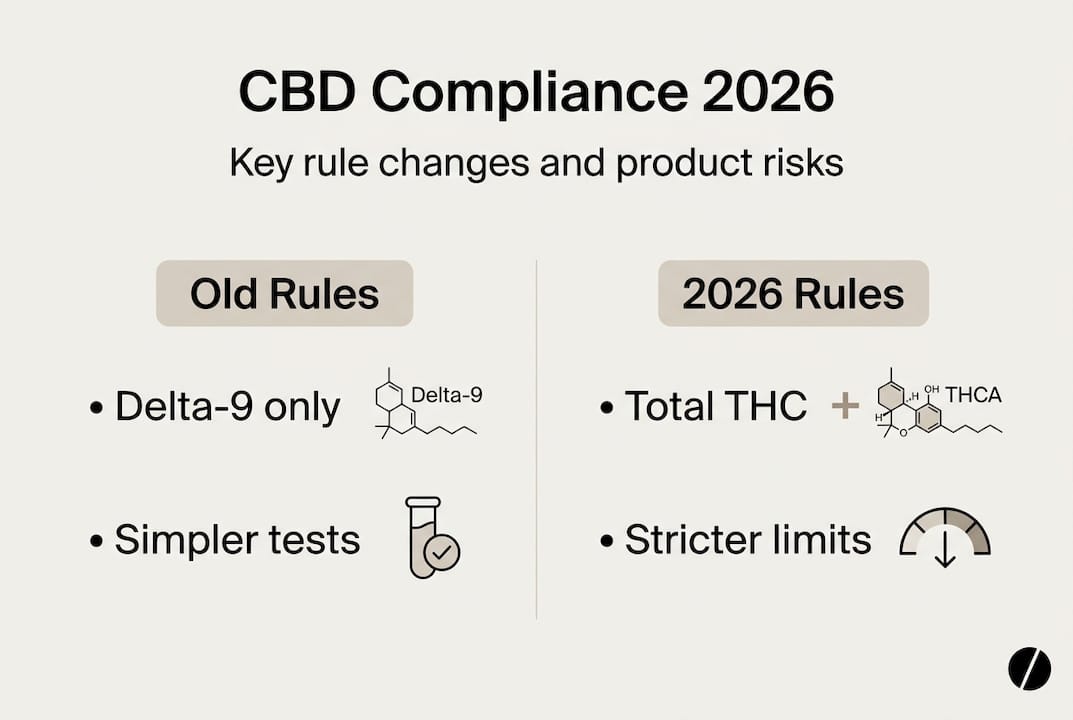
The biggest shift coming is the move from a delta-9-only compliance threshold to a total THC standard. Under the 2025 Continuing Resolution (H.R. 5371, Section 781, effective November 12, 2026), all THC analogs count toward the compliance limit. That means delta-9, THCA, and other naturally occurring analogs are all included. Synthetic cannabinoids like Delta-8 THC made from CBD conversion are excluded from the hemp definition entirely.
The new thresholds are strict: intermediates must stay at ≤0.3% total THC by dry weight, and final products must contain ≤0.4 mg per container. That second number is extremely tight. Most full-spectrum products on shelves today exceed it.
Here is how the old and new definitions compare:
| Feature | Old rule (pre-2026) | New rule (2026 and beyond) |
|---|---|---|
| THC measured | Delta-9 only | Total THC (delta-9, THCA, analogs) |
| Synthetics included | Yes (gray area) | No, banned outright |
| Final product limit | ≤0.3% by dry weight | ≤0.4 mg per container |
| Full-spectrum products | Mostly compliant | Mostly non-compliant |
| Delta-8/Delta-10 | Legal gray area | Federally banned |
The products most at risk are full-spectrum oils, vape cartridges, and gummies. These formats naturally carry higher total cannabinoid loads, and reformulating them to meet the new per-container limit is a significant technical challenge. Broad-spectrum and isolate-based products are in a much better position, since they start with lower total THC baselines.
State laws can also be stricter than the federal baseline. Check 2026 THC limits for your specific state before assuming federal compliance is enough.
Pro Tip: Start reformulating now and run full-panel lab tests that include THCA and all analogs, not just delta-9. Waiting until November to find out your flagship product fails is not a recoverable situation. Use a certified ISO 17025 lab and get CBD product eligibility confirmed well before the deadline.
Core compliance requirements for your CBD business
With the rule change clear, what does true compliance look like in day-to-day business? It is not just about THC levels. It is a full operational framework. Here are the core steps every CBD business needs to have in place:
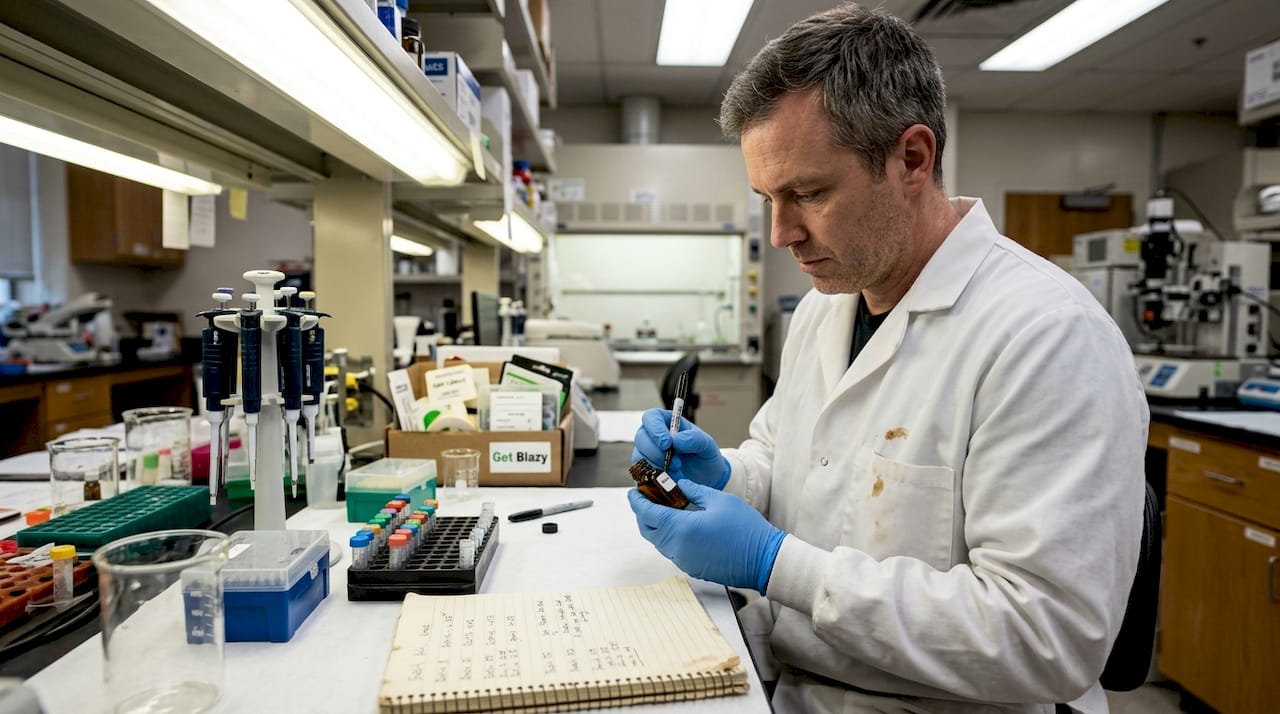
- Third-party lab testing: Use ISO 17025-accredited labs for every production batch. Your Certificate of Analysis (COA) must cover total THC, all cannabinoids, pesticides, heavy metals, and microbials.
- cGMP manufacturing: Current Good Manufacturing Practices are now the industry standard. If your manufacturer is not cGMP-certified, find one that is.
- State licenses: Confirm you hold the correct retail, distribution, or processing license for every state you operate in.
- Age verification technology: Use software-based age gates for online sales and train staff on in-store ID protocols.
- Compliant labeling: No health claims, accurate cannabinoid content, batch numbers, and QR codes linking to COAs.
- Child-resistant packaging: Required for ingestibles in most markets. Non-negotiable for edibles and tinctures.
- Product liability insurance: Protects against claims and is increasingly required by retail partners and carriers.
Here is a realistic cost benchmark for core compliance tools:
| Compliance item | Estimated annual cost |
|---|---|
| Full-panel lab testing (per batch) | $200 to $500 per test |
| Product liability insurance | $2,000 to $5,000/yr |
| cGMP certification (manufacturer) | $5,000 to $15,000 |
| Compliance tracking software | $1,000 to $3,000/yr |
| State licensing fees | $300 to $2,500 per state |
Pro Tip: Invest in compliance management software that tracks state rule changes automatically. The regulations shift often enough that manual tracking is a liability. Many platforms also handle age verification and CBD retail compliance documentation in one place.
The most common pitfalls are using unverified labs, making vague health claims, and shipping across state lines without checking destination-state rules. A single mislabeled batch or an unverified COA can trigger an FDA warning letter, a carrier hold, or worse.
Navigating FDA, state, and carrier restrictions
Even with perfect compliance, the maze is not over. Federal legality, state rules, and major carrier policies all operate independently, and a gap in any one of them can shut down your operations.
Carriers are a real pressure point. USPS, UPS, and FedEx all require up-to-date COA documentation for CBD shipments and restrict or ban products containing synthetics. If your product has Delta-8 or any converted cannabinoid, it will not move through major carriers post-2026. Some carriers require signed compliance agreements and reserve the right to inspect shipments.
State differences add another layer of complexity:
- Idaho, Nebraska, and South Dakota maintain near-total bans on CBD products.
- Texas and Indiana restrict CBD edibles and have specific labeling requirements.
- California and Colorado have their own state-level hemp programs with additional testing requirements.
- New York requires separate state registration for hemp extract products.
“Federal changes don’t override local bans. A product legal under the new federal hemp definition can still be seized, fined, or prosecuted under state law.”
The FDA’s enforcement focus in 2026 is concentrated on ingestibles, products with child-appeal packaging, and anything making disease or health claims. Their policy is under OIRA review, meaning formal rulemaking is still pending, but enforcement actions are already happening. Do not assume silence means approval.
The smartest operational move is to segment your market by state. Know exactly where you can sell, what formats are permitted, and which carriers service those routes. Review CBD state rules for your target markets and build your distribution map around what is actually legal, not what you hope will be tolerated.
Why real CBD compliance means building for disruption, not certainty
Here is the uncomfortable truth most wellness entrepreneurs do not want to hear: the rules are not going to settle down. Waiting for regulatory clarity before investing in compliance systems is a strategy that has already cost dozens of brands their market position.
We have watched brands in this space operate at the bare minimum, assuming each new rule would be the last. Then 2026 arrived and their entire product line needed reformulation. Meanwhile, the brands that built above-minimum standards, ran full-panel testing years before it was required, and documented everything were the ones that stayed on shelves when others were delisted.
Compliance is not just a cost center. It is a trust signal. Customers are increasingly reading COAs. Retail partners are asking for cGMP documentation before onboarding vendors. Insurance carriers are requiring proof of state licensing. The CBD market strategies that win long-term are built on legitimacy, not loopholes.
Treat your compliance infrastructure the same way you treat your formulations: as something worth investing in, refining, and protecting. The brands that survive the next regulatory cycle will be the ones that built systems adaptable enough to absorb the next change without crisis.
How Get Blazy can help you navigate CBD compliance
If you are sourcing or selling CBD products and want to stay on the right side of 2026 regulations, working with a vetted, compliance-focused partner matters more than ever.
At Get Blazy CBD Dispensary, every product in our catalog is sourced from manufacturers who meet current lab testing and documentation standards. We only carry compliant CBD products backed by third-party COAs, so you know what you are getting meets the standards your customers and regulators expect. Whether you are building a retail assortment or looking for reliable sourcing in the Miami market, Get Blazy is built for the post-2026 landscape. Browse our selection in-store on Biscayne Blvd or order online for fast delivery across Miami.
Frequently asked questions
Is CBD legal in every state after the 2026 rule change?
No. Federal law sets a baseline but many states maintain their own bans or stricter standards, especially for edibles and ingestible supplements. Always verify your destination state’s rules before shipping.
What is a COA, and do I need one for every batch?
A Certificate of Analysis is a third-party lab report confirming your product’s cannabinoid content and contaminant levels. Yes, every production batch requires a new COA under 2026 compliance standards.
What happens if my product fails the new total THC limit?
It may be reclassified as a Schedule 1 controlled substance, exposing your business to federal and state criminal or civil penalties. Distribution and sale would both be illegal.
Can I sell full-spectrum or Delta-8 CBD after 2026?
Most full-spectrum products and all synthetic cannabinoids like Delta-8 and Delta-10 will be federally non-compliant after November 2026. Reformulation to broad-spectrum or isolate is the viable path forward.
Does the FDA allow CBD in dietary supplements or foods?
No. The FDA prohibits CBD as an ingredient in food, beverages, or dietary supplements under the FD&C Act, regardless of THC content or hemp-derived status.