Most people assume all CBD products work the same way. They don’t. The route you choose changes everything about how fast CBD reaches your bloodstream and how much of it actually gets there. Sublingual CBD tinctures offer bioavailability of 20 to 40%, nearly double what you get from swallowing a capsule or edible. For Miami residents navigating high-stress lifestyles, that difference is not a minor detail. It shapes how quickly you feel relief, how much product you need, and whether CBD actually fits into your daily wellness routine in a meaningful way.
Table of Contents
- How CBD tinctures work: Bioavailability and mechanisms
- Evidence-backed wellness benefits: Anxiety, sleep, and pain relief
- Bioavailability boosters and practical dosing tips
- Nuances, edge cases, and placebo effects: What Miami residents should know
- Our expert take: What most articles get wrong about CBD tinctures for wellness
- Enhance your wellness with premium CBD tinctures from Get Blazy
- Frequently asked questions
Key Takeaways
| Point | Details |
|---|---|
| Superior absorption | CBD tinctures offer higher bioavailability than oral CBD forms for faster, more effective results. |
| Evidence-backed benefits | Clinical and observational studies support pain relief, sleep improvement, and anxiety reduction with CBD tinctures. |
| Maximize effectiveness | Pair tinctures with high-fat meals or advanced formulations to boost absorption and outcomes. |
| Safety and nuance | CBD tinctures are generally safe but require careful dosing and awareness of potential drug interactions. |
| Manage expectations | Some studies find placebo effects or limited anxiety benefit; individual response may vary. |
How CBD tinctures work: Bioavailability and mechanisms
With the groundwork laid, let’s explore how CBD tinctures actually deliver their benefits. When you place a tincture under your tongue, the tissue there is thin and rich with blood vessels. CBD absorbs directly into your bloodstream, skipping the digestive system entirely. This is called the sublingual route, and it matters because swallowing CBD forces it through your liver first, a process known as first-pass metabolism that destroys a large portion of the compound before it ever reaches circulation.
Sublingual CBD absorption reaches 20 to 40% bioavailability, compared to just 6 to 20% for oral forms. That gap is significant when you’re trying to get consistent, reliable results from your wellness routine.
| Delivery method | Bioavailability range | Onset time |
|---|---|---|
| Sublingual tincture | 20 to 40% | 15 to 45 minutes |
| Oral capsule or edible | 6 to 20% | 45 to 90 minutes |
| Vape inhalation | 34 to 56% | 2 to 10 minutes |
Once in your bloodstream, CBD works through a network called the endocannabinoid system (ECS), a regulatory system that helps maintain balance across sleep, mood, pain, and immune function. But CBD does not bind directly to the main ECS receptors (CB1 and CB2) the way THC does. Instead, CBD interacts with multiple receptors, including serotonin receptors, TRPV1 (which regulates pain and temperature), and GPR55, influencing inflammation and neurotransmitter balance in a more indirect, nuanced way.
This is called polypharmacology, meaning CBD touches several biological pathways rather than one. It’s part of why the effects feel broad rather than sharp.
- Hold the tincture under your tongue for 60 to 90 seconds before swallowing
- Avoid eating or drinking immediately before dosing to keep the tissue clear
- Use a consistent time of day to help your body build a rhythm
Pro Tip: Set a timer when you dose. Most people swallow too early and lose a significant portion of the absorption window.
Evidence-backed wellness benefits: Anxiety, sleep, and pain relief
Understanding CBD’s mechanism sets up the evidence for its practical impacts on wellness. The research landscape is mixed but genuinely promising in several areas.
“Full-spectrum CBD oils at 100mg per day improved migraine disability and sleep quality in observational studies, and Epidiolex, a pharmaceutical CBD, is FDA-approved for epilepsy.”
Empirical findings point to real benefits for pain and sleep, particularly in people dealing with migraines and neuropathic conditions. This is not anecdote. These are structured studies with measurable outcomes.
| Wellness area | Evidence level | Notes |
|---|---|---|
| Epilepsy (Epidiolex) | FDA-approved | Strongest clinical evidence |
| Migraine and pain | Observational studies | Promising, more RCTs needed |
| Sleep improvement | Observational studies | Linked to pain reduction |
| Anxiety reduction | Mixed results | Some RCTs show no benefit vs placebo |
Here’s what the evidence actually supports, ranked by strength:
- Epilepsy management is the gold standard, with an approved pharmaceutical product and robust trial data
- Pain relief, especially for migraine and neuropathic pain, shows consistent observational support
- Sleep improvement often follows pain reduction rather than acting as a standalone effect
- Anxiety and stress show promise in some studies but remain inconsistent across clinical trials
CBD’s polypharmacology helps explain why it supports such a wide range of conditions, from psychiatric symptoms and nausea to neurodegeneration. The same multi-receptor activity that makes it hard to pin down also makes it broadly useful.
The key takeaway here is nuance. CBD tinctures are not a cure. They are a support tool, and the migraine and sleep effects documented in recent research suggest they work best as part of a consistent wellness practice rather than a one-time fix.
Bioavailability boosters and practical dosing tips
With a clear picture of CBD’s benefits, let’s look at how to enhance and safely use tinctures. What you eat before dosing changes how much CBD your body actually absorbs. A lot.
High-fat meals and advanced formulations like nano-emulsions and lipid nanoparticles can boost bioavailability by 291 to 455% compared to standard oral formats. Even a simple high-fat meal can push absorption from the baseline oral range up to 36 to 57%.
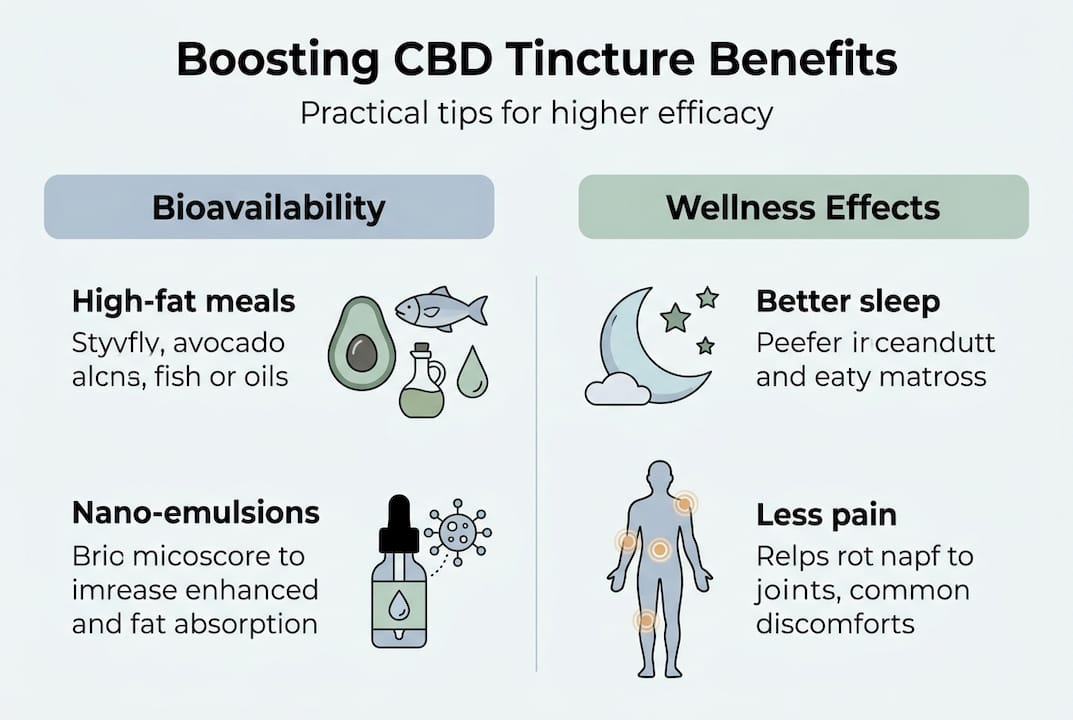
Statistic to know: Nanoparticle formulations have shown up to a 455% increase in CBD absorption compared to standard oral delivery.
For sublingual tinctures, pairing your dose with a fatty snack like avocado, nuts, or full-fat yogurt can meaningfully improve how much CBD reaches your system. This is especially relevant for Miami residents who may be dosing in the morning before a light breakfast.
- Start with 25 to 50mg per day and increase slowly over one to two weeks
- Track your response in a simple journal: mood, sleep quality, pain levels
- Watch for mild side effects like drowsiness, loose stools, or appetite changes
- Avoid doubling doses if you don’t feel effects immediately; CBD has a long half-life
That last point is critical. The safety profile of CBD includes a half-life exceeding 134 hours with repeated use, meaning the compound accumulates in your system over time. Effects often improve after one to two weeks of consistent use, not after the first dose.
Pro Tip: If you’re not feeling results after three days, don’t increase your dose yet. Give it two full weeks of consistent use before adjusting. CBD builds in your system gradually.
At high doses, liver enzyme monitoring is advisable, particularly if you’re using CBD alongside other medications. Keep your healthcare provider in the loop.
Nuances, edge cases, and placebo effects: What Miami residents should know
Maximizing bioavailability is important, but understanding risks and limitations completes the picture. CBD is generally well-tolerated, but it is not without complexity.
One of the most important things to understand is how CBD interacts with other medications. CBD inhibits CYP3A4 and CYP2C19, two liver enzymes responsible for metabolizing a wide range of common drugs, including blood thinners, antidepressants, and anticonvulsants. If you take any prescription medication, a conversation with your doctor before starting CBD is not optional, it’s essential.
Edge cases worth knowing:
- Essential tremor: Some users report improvement, but evidence is limited
- Hepatic impairment: CBD is processed by the liver; those with liver conditions need medical guidance
- Epilepsy: Only pharmaceutical-grade CBD (Epidiolex) has clinical approval; over-the-counter tinctures are not equivalent
- Pregnancy and breastfeeding: Avoid CBD entirely; safety data is insufficient
Mild side effects reported in studies include somnolence (drowsiness), diarrhea, and appetite changes. These are generally dose-dependent and resolve with adjustment.
“Some randomized controlled trials show no significant benefit for anxiety or stress compared to placebo, which means individual results can vary widely.”
The placebo effect in CBD studies is real and worth acknowledging. If you feel better after starting CBD, that’s meaningful, but it may not be purely pharmacological. This doesn’t make the benefit less valid. It does mean you should track your results honestly rather than assuming CBD is doing all the work.
Our expert take: What most articles get wrong about CBD tinctures for wellness
Armed with science and evidence, here’s an honest perspective on what really works. Most CBD guides focus on dosage charts and product comparisons. What they miss is that formulation, diet, and individual biology matter just as much as the milligram count on the label.
We see Miami customers come in expecting immediate, dramatic results. The reality is that CBD tinctures work best as a slow-build wellness tool, not a fast-acting remedy. The entourage effect in full-spectrum oils may amplify benefits through the combined action of cannabinoids and terpenes, but trace THC in those same products can create complications for people subject to drug testing or with THC sensitivity. Always read the label.
The empirical evidence is strongest for pain and epilepsy. Anxiety and sleep support are promising but not guaranteed. Urban stress in Miami is real, and natural relaxation tools have genuine value. But the most important thing we can tell you is this: manage your expectations, stay consistent, and pay attention to how your body actually responds rather than how you hope it will.
Enhance your wellness with premium CBD tinctures from Get Blazy
If you’re ready to experience the science-backed benefits covered in this article, Get Blazy CBD Dispensary on Biscayne Blvd in Miami has you covered.
We carry a curated CBD tincture selection that includes full-spectrum, broad-spectrum, and isolate options, all lab-tested for purity and potency. Whether you’re new to CBD or refining your existing routine, our team can help you find the right formulation and dosage for your goals. Miami residents can shop in-store or order online for fast, discreet delivery. Your wellness routine deserves products you can actually trust.
Frequently asked questions
How do CBD tinctures differ from CBD oils or edibles?
CBD tinctures are held under the tongue for direct bloodstream absorption, giving them higher bioavailability than swallowed oils or edibles that pass through the digestive system first.
Are CBD tinctures safe for daily use?
Yes, for most people. The safety profile includes mild, manageable side effects, though liver enzyme monitoring is recommended at higher doses.
Can CBD tinctures help with anxiety or stress?
Some studies show real promise, but not all clinical trials find significant benefit over placebo, so results vary by individual.
How can I maximize the efficacy of CBD tinctures?
Take your tincture with a high-fat snack and hold it under your tongue for 60 to 90 seconds. Advanced formulations like nano-emulsions also significantly boost absorption.
Are there drug interactions or contraindications with CBD tinctures?
Yes. CBD inhibits CYP3A4/2C19 liver enzymes, which can affect how your body processes many common medications, so always consult your healthcare provider first.