TL;DR:
- Many CBD products are mislabeled, potentially containing undeclared THC or incorrect concentrations.
- Full-spectrum, broad-spectrum, and isolate differ in cannabinoid content and drug test risk.
- Always verify product labels with third-party lab reports (COAs) to ensure safety and accuracy.
Not all CBD products are the same, and assuming otherwise can cost you more than money. Miami’s hemp market is growing fast, and with that growth comes a flood of labels packed with terms most buyers have never had explained to them. Words like “full-spectrum,” “COA,” and “entourage effect” aren’t just marketing language — they carry real implications for your health, your wallet, and yes, even your job. Research shows that roughly 25% of CBD products are mislabeled for cannabinoid content, including undeclared THC. This guide breaks down every key term so you can shop with confidence.
Table of Contents
- Why CBD terminology matters for Miami consumers
- The essential glossary of CBD industry terms
- CBD product types: Full-spectrum vs. broad-spectrum vs. isolate
- How to read CBD labels and avoid common pitfalls
- What most buyers miss about CBD terminology
- Get trusted CBD products in Miami
- Frequently asked questions
Key Takeaways
| Point | Details |
|---|---|
| Learn the terminology | Knowing basic CBD terms ensures you can understand products and make safe choices. |
| Product types matter | Full-spectrum, broad-spectrum, and isolate have different THC levels, entourage effects, and implications for use. |
| Check lab reports | Always look for third-party Certificates of Analysis confirming purity and THC content. |
| Beware mislabeled products | Nearly 1 in 4 CBD products are inaccurately labeled, highlighting the need for careful review. |
Why CBD terminology matters for Miami consumers
Miami’s legal hemp market is one of the most active in Florida, and that’s a good thing. But a busy market also means more products, more brands, and more opportunities for confusion. When you walk into a dispensary or browse online, you’re often choosing between products that look similar but behave very differently inside your body.
The three most common product categories — full-spectrum, broad-spectrum, and isolate — each have different cannabinoid profiles. If you don’t know what those terms mean, you can’t make an informed choice. And in Miami, where many residents work in industries with strict drug testing policies, picking the wrong product isn’t just a minor inconvenience.
Here’s why terminology knowledge protects you directly:
- Full-spectrum products contain trace amounts of THC, which can accumulate in your system over time
- Broad-spectrum products have THC removed, but “removed” doesn’t always mean “gone”
- Isolate products are marketed as pure CBD, but contamination is still possible
- Mislabeling is more common than most consumers realize, affecting both CBD concentration and THC content
- Buzzwords like “natural,” “organic,” and “pure” are not regulated terms in the hemp industry
“Knowledge is the only protection you have when a label can legally say almost anything.”
A peer-reviewed study found that approximately 25% of hemp-derived products carried inaccurate labeling, including undeclared THC and incorrect CBD concentrations. That statistic should change how you shop. Understanding what you’re reading on a label is the first and most important step toward safe, effective CBD use in Miami.
The essential glossary of CBD industry terms
Let’s cut through the noise. Here are the terms you’ll see on reputable CBD packaging and what they actually mean.
- Full-spectrum CBD: Contains all naturally occurring cannabinoids from the hemp plant, including trace THC (under 0.3% by dry weight), terpenes, and flavonoids. According to wellness research, full-spectrum CBD enables the entourage effect where plant compounds work together for potentially enhanced benefits.
- Broad-spectrum CBD: Includes multiple cannabinoids and terpenes but has THC removed through additional processing. It aims to deliver entourage benefits without psychoactive risk.
- CBD isolate: The most processed form. Pure CBD with no other cannabinoids, terpenes, or THC present.
- Entourage effect: The theory that cannabinoids and terpenes work better together than in isolation. Think of it like a band — each instrument adds something the solo can’t.
- Cannabinoids: Active compounds produced by the hemp plant. CBD and THC are the most well-known, but there are over 100 others including CBG, CBN, and CBC.
- Terpenes: Aromatic compounds found in hemp (and many other plants) that contribute to scent, flavor, and potentially therapeutic effects.
- COA (Certificate of Analysis): A third-party lab report that verifies what’s actually in the product. This is your most important document when buying CBD.
- Phytochemicals: Plant-derived chemical compounds. In hemp, this includes cannabinoids, terpenes, and flavonoids.
- Carrier oil: The base oil used to dilute CBD extract — common options include MCT oil, hemp seed oil, and olive oil. Carrier oils affect absorption rate.
- Bioavailability: How much of a substance actually enters your bloodstream and produces an effect. Different delivery methods (tinctures, edibles, vapes) have very different bioavailability rates.
Pro Tip: Before buying any CBD product, search for its COA using the batch number on the label. A legitimate COA will show cannabinoid percentages, confirm THC levels, and flag any pesticides, heavy metals, or residual solvents.
CBD product types: Full-spectrum vs. broad-spectrum vs. isolate
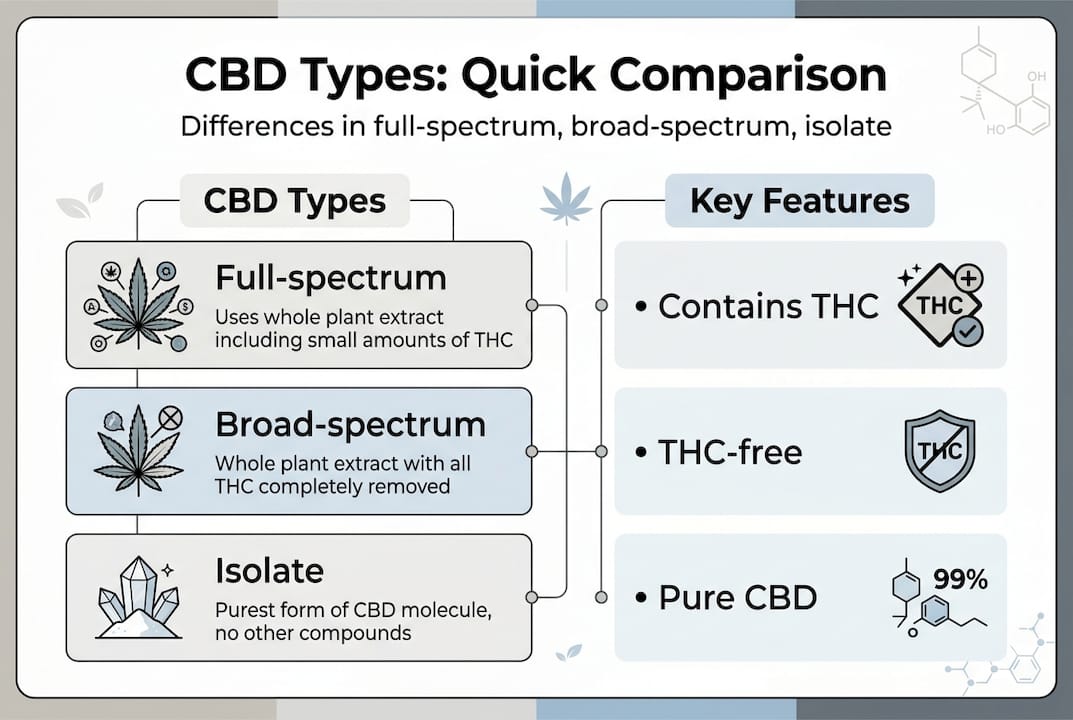
Now that you know the terms, here’s how the three main product types actually compare side by side.
| Feature | Full-spectrum | Broad-spectrum | Isolate |
|---|---|---|---|
| THC present | Yes (under 0.3%) | No (removed) | No |
| Entourage effect | Yes | Partial | No |
| Drug test risk | Higher | Lower | Lowest |
| Processing level | Minimal | Moderate | High |
| Best for | Maximum plant benefit | Balance without THC | Precise dosing |
Research confirms that broad-spectrum CBD provides entourage benefits without psychoactive risk, while CBD isolate is 99%+ pure CBD with no other plant compounds present.
Here’s when each type makes the most sense:
- Choose full-spectrum if you want the full range of hemp plant benefits and you’re not subject to drug testing.
- Choose broad-spectrum if you want entourage benefits but need to minimize THC exposure for work or personal reasons.
- Choose isolate if you need precise, measurable CBD doses and want the lowest possible risk of any other cannabinoids.
- Choose isolate or broad-spectrum if you’re new to CBD and want a predictable, controlled experience.
- Choose full-spectrum if you’ve already tried isolate without results and want to explore whether the entourage effect makes a difference for you.
Pro Tip: Products labeled “THC-free” are almost always broad-spectrum or isolate. But “THC-free” is a marketing claim, not a guarantee. Always pull the COA and check the actual numbers.
How to read CBD labels and avoid common pitfalls
You now have the vocabulary. Here’s how to use it when you’re standing in front of a shelf or scrolling through a product page.
A standard CBD product label should include the following:
- Total CBD content listed in milligrams (not just percentage)
- Product type clearly stated: full-spectrum, broad-spectrum, or isolate
- Batch or lot number that links to a specific COA
- Serving size and number of servings so you can calculate dose per use
- Ingredients list including carrier oil and any additives
| Label term | What it means | Red flag? |
|---|---|---|
| Full-spectrum | Contains trace THC | Not a red flag, but verify THC level |
| Broad-spectrum | THC removed | Verify via COA — “removed” isn’t always 100% |
| THC-free | Marketing claim | Red flag if no COA backs it up |
| Hemp extract | Could be anything | Red flag if CBD mg not listed |
| Natural / Organic | Unregulated terms | Red flag if no third-party testing |
| 99% pure CBD | Isolate claim | Verify via COA for contaminants |
Studies confirm that about 25% of hemp products carry inaccurate labels, including undeclared THC that could affect drug test results. That’s not a rare edge case — it’s a real pattern across the industry.
Pro Tip: If a product doesn’t have a batch number or a scannable QR code linking to a COA, put it back. Transparency is the baseline standard for any reputable brand.
What most buyers miss about CBD terminology
Here’s the uncomfortable truth: most people buying CBD in Miami are choosing products based on packaging aesthetics and buzzwords. “Natural.” “Pure.” “Organic.” These words feel reassuring, but they carry no legal definition in the hemp space. A product can call itself “pure” and still contain undeclared cannabinoids or contaminants.
What actually matters is the COA. And yet, most buyers never look at one. The entourage effect may enhance efficacy according to preclinical data, but that potential benefit means nothing if you can’t verify what’s actually in your product. For Miami residents subject to workplace drug testing, the stakes are even higher. The legal THC limit of under 0.3% sounds small, but it can accumulate with daily use of full-spectrum products.
The CBD industry is still working toward standardization. Lab testing requirements, labeling rules, and potency verification are improving, but they’re not uniform yet. That means self-education isn’t optional — it’s your primary protection. Demand to see lab results. Ask where the hemp was grown. Check the batch number. These aren’t extra steps; they’re the minimum.
Pro Tip: Real safety comes from verified, transparent reporting. If a brand can’t show you a current COA, that tells you everything you need to know.
Get trusted CBD products in Miami
Now that you know how to read labels, identify product types, and spot red flags, you’re ready to shop with real confidence. At Get Blazy CBD, every product in our Miami store is lab-tested and sourced from reputable manufacturers who provide full transparency.
Whether you’re looking for full-spectrum tinctures, broad-spectrum gummies, or isolate-based topicals, our team on Biscayne Blvd can walk you through the COA for any product you’re considering. Shop in-store or order online for fast delivery across Miami. You’ve done the learning — let us help you put it into practice with products you can actually trust.
Frequently asked questions
What is the entourage effect in CBD products?
The entourage effect describes how CBD combined with all cannabinoids and terpenes in full-spectrum or broad-spectrum products may produce enhanced benefits compared to pure isolate, where those compounds are absent.
Why does the type of CBD matter for drug tests?
Full-spectrum contains trace THC that can accumulate with regular use and trigger a positive result; mislabeled broad-spectrum or isolate products can also carry unexpected THC if contamination occurred during processing.
How can I tell if a CBD product is mislabeled?
Always locate the batch number on the label and request the corresponding third-party COA; about 25% of products carry inaccurate labeling, so skipping this step is a real risk.
Is CBD isolate always safer than other forms?
CBD isolate is 99%+ pure CBD with no other cannabinoids present, but it still requires third-party testing to confirm the absence of contaminants like pesticides, heavy metals, or residual solvents.