TL;DR:
- CBD interacts indirectly with the endocannabinoid system to promote biological balance.
- Research shows CBD can reduce anxiety by activating serotonin receptors and modulating neural activity.
- Safety considerations include drug interactions, product quality, and appropriate dosing, especially for medication users.
Most people assume CBD simply “relaxes” you the way a warm bath might, but that framing misses nearly everything important about how the compound actually functions. CBD triggers a cascade of biological events involving receptors, neurotransmitters, and immune signals throughout your body. For Miami adults navigating daily stress, heat, and an always-on lifestyle, understanding these mechanisms is the difference between choosing a product that works and wasting money on something that does not. This guide covers how CBD interacts with your biology, what credible research actually shows about stress relief, and the real safety considerations most articles skip entirely.
Table of Contents
- Understanding how CBD interacts with your body
- CBD and stress relief: What the science says
- CBD’s role in inflammation, pain, and overall health
- Considerations, safety, and what most articles miss
- What most people overlook about CBD for natural wellness
- Explore top CBD and wellness options in Miami
- Frequently asked questions
Key Takeaways
| Point | Details |
|---|---|
| CBD modulates your body | It influences your internal systems by modulating key receptors and boosting the body’s own cannabinoids. |
| Potential for stress relief | Clinical research supports CBD’s ability to reduce anxiety and promote relaxation, though effects can vary. |
| Safety and quality matter | Individual responses differ and it’s crucial to consider dosage, consult a doctor, and choose high-quality products. |
| Not a one-size-fits-all solution | Outcomes depend on the right product, dose, and personal health—customization is key for best results. |
Understanding how CBD interacts with your body
With the misconception dispelled, let’s dive into what actually happens when CBD enters your body.
Your body already runs a built-in chemical communication network called the endocannabinoid system, or ECS. It helps regulate mood, sleep, appetite, pain perception, and immune response. This system relies on two primary receptor types, CB1 and CB2, distributed throughout your brain, organs, and immune tissue. Think of these receptors as locks and the body’s own cannabinoids as keys.
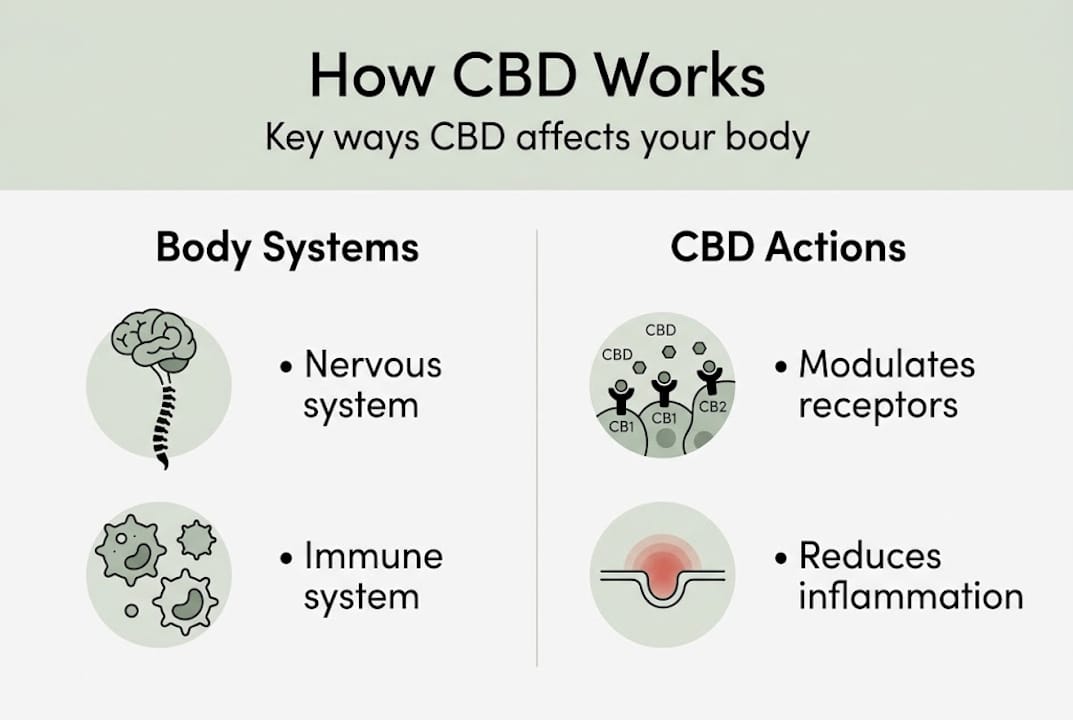
Here is where CBD gets interesting. Unlike THC, which fits directly into CB1 receptors and produces intoxicating effects, CBD does not bind the same way. The endocannabinoid system (ECS) basics research confirms that CBD primarily interacts indirectly with the ECS by modulating CB1 and CB2 receptors as an inverse agonist or allosteric modulator, meaning it changes how those receptors respond rather than switching them on directly.
One practical result: CBD slows the breakdown of anandamide, your body’s naturally produced “bliss molecule.” More anandamide circulating means calmer neural activity and a greater sense of balance, without the high THC produces.
Here is a quick breakdown of what CBD touches in your biology:
- CB1 receptors: Found mainly in the brain and central nervous system; influence mood, memory, and pain
- CB2 receptors: Found mainly in immune tissue; involved in inflammation and immune response
- 5-HT1A serotonin receptors: Directly activated by CBD; strongly tied to anxiety and mood regulation
- TRPV1 channels: Involved in pain and temperature perception; CBD modulates these as well
- Neural signaling: CBD slows excitatory neuron firing, reducing the sensation of overwhelm
Key insight: CBD does not flood your receptors the way a pharmaceutical drug might. Instead, it nudges your existing system toward balance, which is why effects feel subtle and cumulative rather than immediate and dramatic.
This indirect approach also explains why CBD affects different people differently. Your baseline ECS activity, stress levels, body weight, and even gut health all shape the outcome.
CBD and stress relief: What the science says
Now that you understand the biological pathways, here is what research shows about CBD’s real-world impact on stress relief.
CBD’s most studied stress-relief mechanism runs through your serotonin system. Specifically, CBD agonizes 5-HT1A receptors, contributing to anxiolytic (anxiety-lowering) effects. Serotonin is the same neurotransmitter targeted by many common antidepressants, but CBD reaches it through a different pathway with a different safety profile.
Preclinical and clinical studies show CBD reduces anxiety and stress in models of social anxiety, PTSD, and general stress. The results are not uniform, but the pattern is consistent enough to matter.
Here is how CBD reduces stress at the biological level:
- ECS modulation: CBD increases anandamide availability, calming hyperactive stress responses
- Serotonin activation: CBD activates 5-HT1A receptors, producing a mood-stabilizing signal
- Reduced neural firing: Calmer serotonin signaling slows overactive stress circuits in the amygdala
- Lower cortisol response: Some studies suggest CBD reduces cortisol output under acute stress
- Improved sleep onset: Less neural hyperactivity at night supports restorative sleep, which itself reduces next-day stress
| Study focus | CBD dose | Outcome |
|---|---|---|
| Social anxiety disorder | 300 mg single dose | Significant reduction in anxiety scores |
| General stress simulation | 600 mg | Reduced autonomic stress markers |
| PTSD symptoms | 25-75 mg daily | Improved sleep and reduced nightmares |
| Healthy volunteers (acute stress) | 300 mg | Blunted cortisol spike |
One notable data point: anxiety scores dropped by as much as 73% in some trials using 300 to 600 mg CBD, though everyday wellness doses are typically much lower. Most people using CBD for mild to moderate daily stress report benefits in the 25 to 75 mg range.
Pro Tip: If you are new to CBD, sublingual tinctures give you the fastest absorption, typically within 15 to 45 minutes. Gummies take longer, 45 to 90 minutes, but effects last further into the evening. Start low and track how you feel before increasing your dose.
CBD’s role in inflammation, pain, and overall health
In addition to stress, CBD’s benefits extend into other key areas for overall well-being.
Inflammation is often the hidden thread connecting stress, pain, and chronic health issues. When your body is under prolonged stress, it triggers a low-level inflammatory response that can worsen mood, disrupt sleep, and increase physical discomfort. CBD addresses this through several pathways. Research shows CBD modulates ion channels and inflammatory pathways, affecting pain, inflammation, and even how your body metabolizes certain substances.

More specifically, CBD suppresses pro-inflammatory cytokines and modulates immune cells, which is the biological mechanism behind its anti-inflammatory reputation. Cytokines are signaling proteins that amplify the inflammatory response. Calming them down is how CBD may ease swelling, soreness, and immune-driven discomfort.
For Miami adults dealing with post-workout soreness, joint pain from an active lifestyle, or the cumulative inflammation that stress builds up over time, this matters practically.
Conditions and symptoms where CBD may provide support:
- Chronic joint pain and muscle soreness
- Exercise-induced inflammation
- Mood disruption linked to inflammatory signals
- Skin irritation and localized swelling (topical use)
- Immune system dysregulation from prolonged stress
| Factor | CBD approach | Conventional approach |
|---|---|---|
| Inflammation source | Modulates cytokines, CB2 receptors | NSAIDs block COX enzymes |
| Pain signaling | Modulates TRPV1 and neural channels | Opioids or analgesics suppress broadly |
| Side effect profile | Generally mild; few at low doses | GI risks, dependency risk |
| Onset of effect | 30 min to 2 hours depending on form | Often faster but more aggressive |
| Long-term use concern | Liver enzymes at high doses | GI damage, tolerance build-up |
CBD is not a replacement for medical care. But as a complementary tool, it addresses inflammatory pathways that many conventional options do not touch without significant trade-offs.
Considerations, safety, and what most articles miss
As with any wellness approach, it is important to consider practical safety and evidence limits.
CBD is not without real risks, and most consumer-facing content glosses over the details that actually matter. The most important consideration is drug interactions. CBD inhibits CYP450 enzymes and can affect how your liver processes dozens of common medications, from blood thinners to antidepressants to cholesterol drugs. If you take any prescription medication, this is not optional to discuss with your doctor.
At high doses, CBD may also raise liver enzyme levels, which is why clinical trials monitor liver function. This effect is dose-dependent and typically seen well above everyday wellness doses, but it is worth knowing.
Beyond pharmacology, product quality is a genuine issue. CBD is not FDA-approved for general wellness (only for the seizure medication Epidiolex), which means the supplement market is loosely regulated. Third-party lab testing is your best safeguard.
Key considerations before starting CBD:
- Talk to your doctor first, especially if you take medications metabolized by the liver
- Choose lab-tested products from brands that publish Certificates of Analysis (COA)
- Start with a low dose, 5 to 10 mg twice daily, and wait at least a week before adjusting
- Track your response in a simple journal: mood, sleep, pain levels, and any side effects
- Avoid if pregnant, breastfeeding, or managing liver disease
Pro Tip: “Start low and go slow” is especially important with edibles. Because they pass through digestion before entering your bloodstream, it is easy to take a second dose thinking the first did not work, only to feel both doses hit at once.
CBD is not FDA-approved for general stress or wellness, and while preclinical data is strong, some clinical trials show mixed results, particularly for long-term anxiety and in people with heavy cannabis histories. Evidence gaps are real. Treat CBD as a promising complement to lifestyle care, not a guaranteed fix.
You can also review CBD supplement safety through clinical references for a deeper look at what the professional literature says.
What most people overlook about CBD for natural wellness
Having covered the facts, it is vital to look beyond common wisdom.
Here is something the wellness industry rarely admits: CBD is a polypharmacological compound, meaning it hits multiple biological targets at once in ways that are still being mapped by researchers. That complexity is a feature, not a flaw, but it also means that anyone promising specific, guaranteed outcomes is oversimplifying.
We see this pattern at Get Blazy. Miami adults who get the most from CBD are not the ones who grab any gummy off the shelf. They are the ones who match the product format, dose, and timing to their specific goals, and who layer CBD on top of decent sleep habits, managed stress, and real food. CBD amplifies a well-maintained system. It struggles to compensate for a neglected one.
The Harvard perspective on CBD echoes this view: individual biochemistry, existing health conditions, and product quality all shape outcomes far more than any single ingredient claim. A 300 mg dose that calms one person may do nothing for another. That is not a failure of CBD. That is biology.
Stop chasing a magic formula. Start treating CBD as one intelligent tool in a broader wellness strategy.
Explore top CBD and wellness options in Miami
Ready to put this insight into practice?
If you are a Miami adult looking to explore CBD for stress relief, inflammation, or general wellness, starting with a quality product from a trusted local source matters more than most people realize. Poorly sourced CBD can contain inaccurate doses, residual solvents, or unlisted compounds that undermine the whole point.
At Get Blazy CBD Dispensary on Biscayne Blvd, every product in our Miami CBD delivery and wellness selection is lab-tested, sourced from reputable manufacturers, and chosen with real wellness goals in mind. Whether you prefer tinctures, gummies, vapes, or topicals, we carry formats that match different lifestyles and goals. Shop in-store or order online for fast, discreet delivery across Miami. Our team is here to help you find what actually fits your situation.
Frequently asked questions
How does CBD differ from THC in the body?
CBD does not bind directly to cannabinoid receptors like THC does. Instead, it modulates CB1/CB2 receptors indirectly, producing calming effects without intoxication or the cognitive disruption THC can cause.
What is the best way to take CBD for stress relief?
Start low with sublingual oils or edibles, aiming for 5 to 10 mg twice daily, and consult a doctor to avoid potential drug interactions before increasing your dose.
Is CBD safe for everyone?
No. CBD can interact with medications and may raise liver enzymes at high doses. CYP450 enzyme inhibition is the biggest concern for people on prescription drugs. Avoid during pregnancy and with liver disease.
Does CBD really work for anxiety and stress?
For many people, yes, but results vary. Some trials show 73% reductions in anxiety scores, while other studies show mixed outcomes, particularly for chronic use or when high-THC history is involved.