TL;DR:
- CBD interacts indirectly with the endocannabinoid system to support daily balance and stress regulation.
- Low doses of CBD often produce placebo-like effects, with higher doses showing measurable anxiolytic benefits.
- Safe and effective use requires starting with low doses, consistent tracking, and sourcing quality, lab-tested products.
Most people who pick up CBD for the first time expect fast, obvious results. A calmer morning, less tension after a long day on Biscayne Blvd, better sleep before a big meeting. The reality is more nuanced, and honestly, more interesting. CBD does interact with real biological systems in your body, but the gap between what the science supports and what marketing promises can be wide. This guide breaks down how CBD actually works, what the research says about daily use, where the risks hide, and how to build a realistic wellness routine around it if you decide it fits your life.
Table of Contents
- How CBD supports everyday balance
- What the research shows: Relaxation, stress, and daily life
- Safety, side effects, and who should avoid CBD
- How to integrate CBD for balanced daily living in Miami
- Why realistic expectations matter when using CBD for balance
- Where to find quality CBD for your Miami wellness routine
- Frequently asked questions
Key Takeaways
| Point | Details |
|---|---|
| CBD supports balance | CBD interacts with your endocannabinoid system and may aid daily balance and relaxation, though most effects are subtle. |
| Evidence is nuanced | Clinical research shows mixed benefits for everyday use—many people experience placebo effects, especially at lower doses. |
| Safety matters | Low doses are generally safe for healthy adults, but drug interactions and health condition risks should be checked with a doctor. |
| Smart usage is key | Start low, track effects, and prioritize third-party tested products for safe integration into your Miami daily routine. |
How CBD supports everyday balance
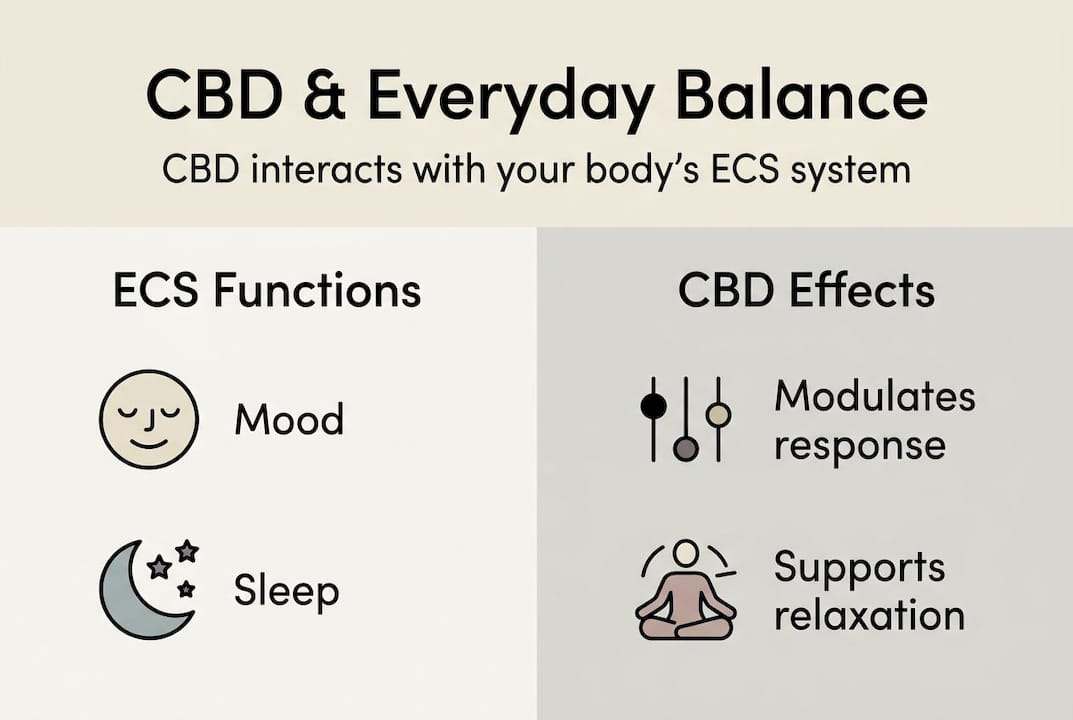
To understand what CBD can realistically do, you need a quick look at the endocannabinoid system, or ECS. Think of the ECS as your body’s internal thermostat. It constantly monitors and adjusts processes like mood, sleep, appetite, and stress response to keep everything in a stable range. That stable range is called homeostasis, which just means your body is running the way it should.
CBD does not attach directly to the ECS’s main receptors the way THC does. Instead, it works more indirectly. It modulates CB1 and CB2 receptors and inhibits an enzyme called FAAH, which breaks down anandamide, a naturally occurring compound sometimes called the “bliss molecule.” By slowing that breakdown, CBD may help your body hold onto more of its own calming chemistry. It also influences serotonin receptors, specifically 5-HT1A, which play a role in mood and anxiety regulation.
Beyond those pathways, CBD is what researchers call a polypharmacological compound. That is a technical way of saying it touches many systems at once. CBD’s mechanisms include effects on TRPV1 ion channels (which regulate pain and inflammation), cytochrome P450 liver enzymes, and inflammatory signaling pathways. All of this happens without producing the high associated with THC.
Core CBD mechanisms at a glance:
- Indirect modulation of CB1 and CB2 receptors in the ECS
- FAAH inhibition, raising anandamide (your body’s natural calming compound)
- Serotonin 5-HT1A receptor influence for mood and relaxation
- TRPV1 channel activity affecting pain and temperature sensitivity
- Anti-inflammatory pathway modulation
- Cytochrome P450 enzyme interaction (important for drug metabolism)
“The ECS plays a fundamental role in maintaining homeostasis across virtually every major organ system. Compounds that modulate this system, even indirectly, have genuine biological relevance for daily balance and stress regulation.”
The honest caveat here is that most of the detailed mechanism research comes from preclinical studies, meaning cell cultures and animal models. Human trials are catching up, but they are still limited in number and scope. That does not make the mechanisms fictional, it just means the translation from lab to lived experience is still being mapped.
What the research shows: Relaxation, stress, and daily life
Here is where things get genuinely surprising. Most people using CBD for everyday wellness are taking relatively low doses, typically under 100mg per day. At those amounts, the clinical picture is much less dramatic than the marketing suggests.
Low-dose CBD in randomized controlled trials (RCTs, the gold standard for medical research) often performs similarly to placebo for stress and anxiety reduction. That does not mean nothing is happening. Placebo responses are real physiological events. But it does mean that if you feel calmer after your morning CBD gummy, the effect may be coming as much from your expectation and routine as from the compound itself.
Higher doses tell a different story. Acute 300mg CBD doses have shown measurable anxiolytic (anxiety-reducing) effects in some trials and can increase feelings of calm during stressful tasks. However, those doses also come with more risk, which we will cover in the next section.
Research outcomes: Low-dose vs. higher-dose CBD
| Outcome | Low dose (under 100mg/day) | Higher dose (150-300mg acute) |
|---|---|---|
| Stress and anxiety reduction | Often matches placebo in RCTs | Some anxiolytic effects in trials |
| Perceived relaxation | Subjective improvement reported | Measurable calm increase noted |
| Physical performance | No significant impact | No significant impact |
| Side effect risk | Low, generally well-tolerated | Higher, especially liver and drug interactions |
| Long-term data | Very limited | Very limited |
One data point worth sitting with: in several wellness-dose trials, placebo groups reported nearly identical improvements in stress and relaxation as CBD groups. This tells us that ritual, expectation, and self-care behavior are powerful forces in their own right.
Pro Tip: Start with 10-25mg per day for two to three weeks before adjusting. Keep a simple journal noting your mood, sleep quality, and stress level each day. That data is far more useful than any single “how do I feel right now” check-in.
The relaxation effects most people notice at everyday doses are real in the sense that they experience them, but the source of that relief is layered. Honest expectations protect you from disappointment and help you evaluate whether CBD is actually earning its place in your routine.
Safety, side effects, and who should avoid CBD
CBD has a solid safety profile at low doses, but “generally safe” does not mean “safe for everyone.” Miami adults who are managing health conditions, taking prescription medications, or living active social lives need to know where the real risks sit.
The most clinically significant concern is drug interactions. CBD inhibits CYP450 enzymes, specifically 3A4, 2C19, and 2C9. These enzymes are responsible for metabolizing a wide range of common medications, including blood thinners like warfarin, anti-seizure drugs like clobazam, and opioids. If CBD slows how your liver processes these drugs, their levels in your blood can rise to potentially dangerous concentrations. Liver enzyme monitoring is recommended if you use CBD regularly at higher doses, especially above 300mg per day or alongside valproate.
Common side effects at everyday wellness doses include drowsiness, diarrhea, reduced appetite, and fatigue. These are usually mild and dose-dependent. The Mayo Clinic notes that CBD is contraindicated during pregnancy and in people with liver disease, and caution is warranted in those with psychiatric conditions.
Groups who should consult a doctor before using CBD:
- People taking blood thinners, anti-seizure medications, or opioids
- Anyone with liver disease or elevated liver enzymes
- Pregnant or breastfeeding individuals
- Those with a history of psychosis or mood disorders
- People on immunosuppressants or certain antidepressants
Pro Tip: Before starting CBD, bring a list of every supplement and medication you take to your doctor or pharmacist. A quick CYP450 interaction check takes minutes and can prevent serious problems.
For Miami’s active lifestyle, this matters in practical ways. If you are heading to a rooftop event or a long beach day, taking a drowsiness-causing dose of CBD beforehand is worth reconsidering. Timing and dose awareness are part of using CBD responsibly.
How to integrate CBD for balanced daily living in Miami
Assuming you have cleared the safety checklist and want to give CBD a fair trial, the approach matters as much as the product. Random use produces random results. A consistent, trackable routine gives you real information.
Building a simple CBD routine:
- Choose your format based on your goal and lifestyle (see table below)
- Start at the lowest effective dose, typically 10-25mg per day
- Take it at the same time each day for at least two weeks
- Log your sleep, mood, and stress daily in a notes app or journal
- Adjust dose by 5-10mg increments only after a full two-week observation period
- Reassess monthly and consult a healthcare provider if anything feels off
CBD product comparison for Miami daily use:
| Product type | Onset time | Typical dose | Miami-friendly use case |
|---|---|---|---|
| Tincture or oil | 15-45 minutes | 10-50mg sublingual | Morning routine, pre-meeting calm |
| Gummies or edibles | 45-90 minutes | 10-25mg | Evening wind-down, weekend relaxation |
| Vape cartridge | 5-15 minutes | Variable, start low | Fast relief, outdoor social settings |
| Topical cream | Local, 20-40 min | Apply as needed | Post-workout muscle tension, beach recovery |
Product quality is not optional. Third-party tested products are the baseline standard. A certificate of analysis (COA) from an independent lab confirms potency, checks for pesticides, heavy metals, and residual solvents, and verifies that THC is within legal limits. No COA, no purchase.
Microdosing, meaning taking smaller amounts more frequently rather than one large daily dose, is gaining traction as a way to get potential CBD effectiveness while minimizing side effects. For Miami’s warm climate and active social calendar, lower doses also mean less risk of drowsiness when you need to be sharp.
Florida law permits hemp-derived CBD with less than 0.3% THC, so you are in the clear for personal use. Just stick to reputable sources and keep your COA accessible.
Why realistic expectations matter when using CBD for balance
Here is our honest take after seeing a lot of people come through our doors looking for a quick fix: CBD is a tool, not a transformation. The people who get the most out of it are the ones who already have solid foundations in place, regular sleep, some form of movement, real social connection, and then use CBD as a mindful addition rather than a substitute for those things.
The research backs this up. At low wellness doses, benefits are often indistinguishable from placebo, and true therapeutic effects tend to require higher doses that carry real risks. That is not a reason to dismiss CBD. It is a reason to be honest about what you are asking it to do.
“True balance comes from sustainable habits. CBD may support those habits, but it cannot replace them. The most effective wellness tool is still the one you use consistently.”
We encourage Miami residents to run small personal experiments. Try CBD for 30 days with a journal. If your numbers improve and you feel better, great. If nothing changes, that is valuable data too. Self-awareness beats brand promises every time.
Where to find quality CBD for your Miami wellness routine
If you are ready to try CBD as part of a thoughtful daily routine, the most important step is sourcing it from a place you can actually trust. Third-party lab testing, transparent labeling, and knowledgeable staff make a real difference when you are trying to make an informed choice.
At Get Blazy CBD Dispensary, we carry a curated selection of lab-tested CBD tinctures, gummies, vape products, and topicals designed for Miami adults who want quality without the guesswork. Shop in-store on Biscayne Blvd or order online for fast, discreet delivery across Miami. Our team is here to help you find the right product and dose for your specific wellness goals.
Frequently asked questions
Does CBD help manage everyday stress?
Low-dose CBD often matches placebo for stress and anxiety in clinical trials, so daily benefits at wellness doses may be largely subjective or placebo-driven rather than purely pharmacological.
Is CBD safe to take every day?
CBD is generally well-tolerated at low doses, but side effects like drowsiness and diarrhea can occur, and it is not recommended for people with liver disease, pregnancy, or those on interacting medications.
What dose of CBD is best for balance and relaxation?
Starting at 10-25mg daily and adjusting slowly is the safest approach. Expert recommendations favor microdosing with careful monitoring over jumping to higher amounts.
How can I choose a quality CBD product in Miami?
Always request a certificate of analysis from a third-party lab. Third-party tested products confirm potency and screen for contaminants, giving you the clearest picture of what you are actually buying.