TL;DR:
- CBD in Miami is legal only if it contains no more than 0.3% delta-9 THC, is properly labeled, and packaged with child-resistant seals. Consumers should verify THC levels with third-party lab results, check for compliance features, and be aware of federal restrictions on CBD food and supplement products. Ensuring product authenticity and adherence to both state and federal laws protects consumers from legal risks and product non-compliance.
Walking into a Miami shop and spotting shelves full of CBD tinctures, gummies, and vape cartridges might make you think the rules are simple. They are not. CBD legality in Miami depends on very specific THC thresholds, labeling requirements, child-resistant packaging rules, and a layer of federal law that state compliance alone cannot resolve. Whether you use CBD for sleep, stress, or everyday balance, understanding exactly where the legal lines sit protects you as a consumer and helps you choose products that genuinely meet Florida’s standards.
Table of Contents
- Understanding Miami’s CBD laws: Key thresholds and rules
- How packaging and THC limits impact CBD legality
- Federal–state confusion: Why some CBD is still federally risky
- Practical tips for buying legal CBD in Miami
- The uncomfortable truth: Why Miami CBD rules are trickier than most realize
- Find compliant CBD with Get Blazy
- Frequently asked questions
Key Takeaways
| Point | Details |
|---|---|
| THC content matters | CBD must have 0.3% or less total delta-9 THC to be legal in Miami. |
| Packaging and labeling | Child-resistant packaging and proper labeling are required for legal CBD products. |
| State vs. federal rules | State legality does not guarantee federal compliance, especially for CBD in foods or supplements. |
| Consumer protection | Keeping purchase receipts and test results can help prove legal compliance if questioned. |
| Safe buying | Use trusted CBD sellers that offer legal, properly labeled products for Miami residents. |
Understanding Miami’s CBD laws: Key thresholds and rules
Miami follows Florida state law when it comes to hemp and CBD products. There is no separate city ordinance that loosens or tightens the state framework, so Florida’s rules are the rules in Miami, full stop.
The foundation of those rules is the THC threshold. Hemp-derived CBD is legal in Florida when it contains no more than 0.3% total delta-9 THC by dry weight. That single number, 0.3%, is the dividing line between a legal hemp product and something that can be treated as a controlled substance. If a product crosses that line, even slightly, it falls into a completely different legal category regardless of how it is marketed.
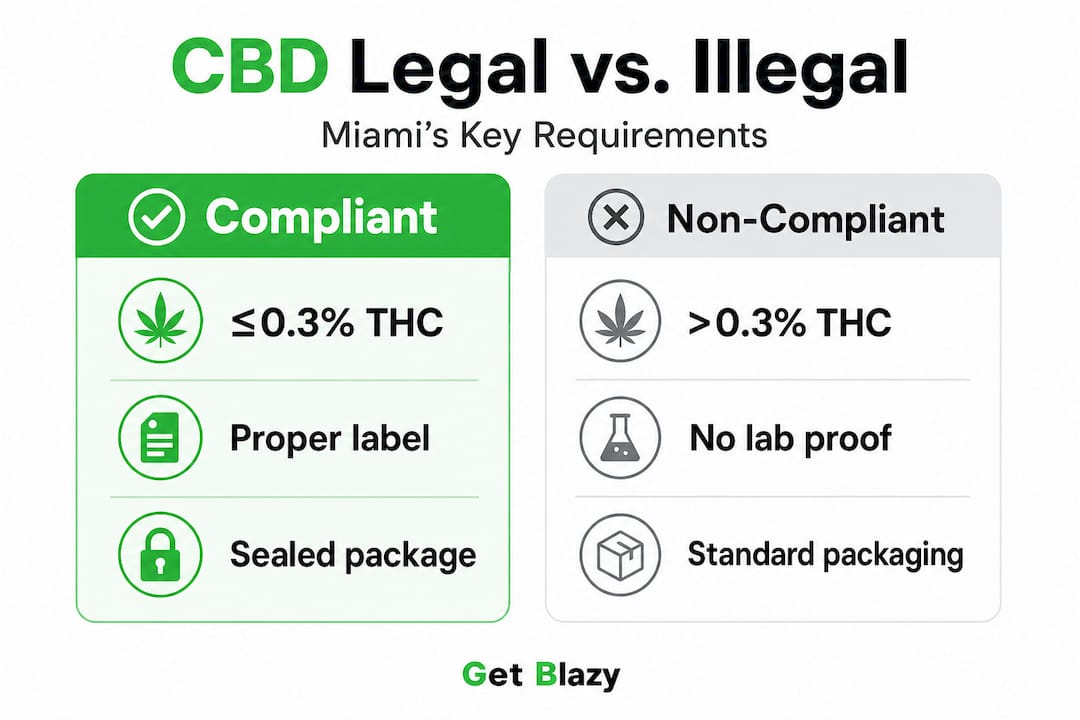
Florida also requires that hemp extracts sold for human consumption meet specific labeling and compliance standards. Products must clearly identify themselves as hemp extract, display batch numbers, and include a scannable QR code or website address that links to a certificate of analysis (COA). A COA is a third-party lab report that confirms the cannabinoid profile and verifies the product is within legal limits.
| Attribute | Legal status in Florida |
|---|---|
| Hemp-derived CBD, ≤0.3% delta-9 THC | Legal |
| Hemp-derived CBD, properly labeled with COA | Legal |
| CBD over 0.3% delta-9 THC | Illegal, subject to detention |
| CBD with no labeling or batch info | Non-compliant, may be seized |
| Marijuana-derived CBD (not hemp) | Illegal without medical card |
The distinction between hemp-derived and marijuana-derived CBD matters enormously. Both plants belong to the cannabis family, but the law treats them very differently based on that THC percentage. You can browse a wide range of hemp-derived options at the CBD product marketplace if you want to see what compliant products actually look like in practice.
Key legal requirements for CBD products in Miami:
- Total delta-9 THC must be at or below 0.3% by dry weight
- Products must carry a hemp extract label and include a certificate of analysis
- Batch numbers and manufacturer contact information must appear on packaging
- QR codes linking to third-party lab results are strongly recommended and often required by retailers
- Products must not make unsubstantiated medical claims on their labels
Florida’s framework came together after the federal 2018 Farm Bill removed hemp from the controlled substances list, but state agencies like the Florida Department of Agriculture and Consumer Services (FDACS) layered additional requirements on top to govern how products are made, labeled, and sold within the state.
How packaging and THC limits impact CBD legality
Once you know the threshold, the next thing to understand is how packaging and labeling can make or break a product’s legal standing even when the THC content is within limits. A product that passes the lab test can still be non-compliant if it lacks the right packaging or labeling.
Florida law mandates child-resistant packaging for hemp extract products sold to consumers. This is not optional. Products that arrive in packaging a child could easily open are in violation of state requirements and can be detained or removed from shelves. This rule exists to protect households with young children and aligns Florida’s hemp rules with standards applied to other regulated products like medications.
Products exceeding the THC threshold face even more serious consequences. Under Florida law, hemp extracts exceeding the THC cap must be detained under Florida Statute Section 500.172. That means FDACS inspectors can pull those products from shelves during routine compliance checks, and retailers who continue to sell them face penalties.
Here is how you can check compliance as a consumer before you buy:
- Look at the label. It should say “hemp extract” and list the manufacturer’s name, batch number, and net weight. If any of these are missing, that is a red flag.
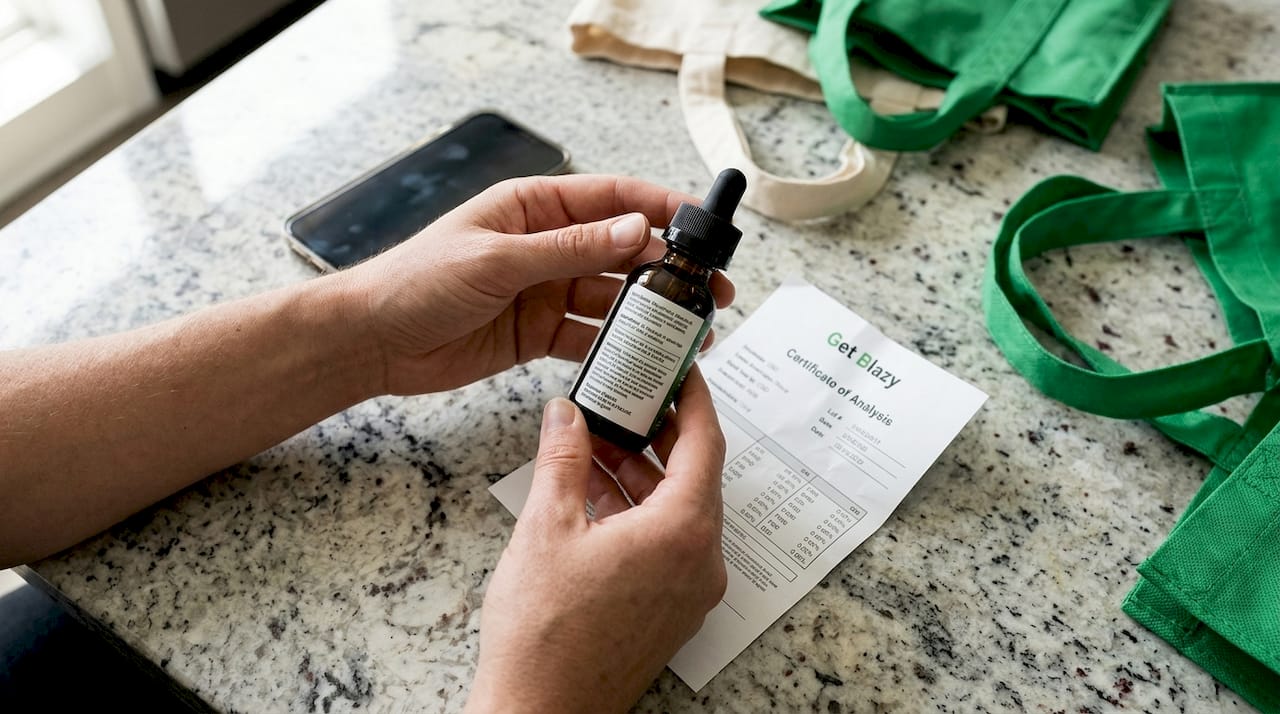
- Scan the QR code. Most compliant products include a QR code that takes you directly to a third-party COA. Pull it up on your phone before purchasing.
- Check the THC percentage on the COA. Look for total delta-9 THC. It must show 0.3% or below. Some COAs will list it in milligrams per gram; 3mg/g equals 0.3%, which is the limit.
- Test the packaging. Give it a squeeze or try the cap. Child-resistant packaging requires a specific motion to open, often press-and-turn or squeeze-and-pull.
- Ask for a receipt and keep it. Having documentation that you purchased from a licensed retailer supports your compliance if you are ever questioned.
Pro Tip: Store your COA screenshot on your phone alongside your purchase receipt for any CBD product you travel with in Miami. If you are ever questioned about the product, you can show documentation of its legal status immediately without needing internet access.
| Feature | Compliant product | Non-compliant product |
|---|---|---|
| Packaging | Child-resistant, sealed | Standard packaging, easy to open |
| Label | Hemp extract, batch number, net weight | Generic or missing key fields |
| THC content | ≤0.3% confirmed by COA | Over limit or untested |
| Lab results | Accessible via QR code or URL | No third-party testing linked |
| Claims | Wellness-focused, no medical promises | Unsubstantiated medical claims |
If you want to skip the guesswork, choosing compliant CBD products from a reputable Miami retailer that pre-screens its inventory for these requirements saves you a lot of time and stress.
Federal–state confusion: Why some CBD is still federally risky
Here is where a lot of Miami residents get tripped up. You buy a product that is fully compliant with Florida law, the THC is under 0.3%, the packaging is child-resistant, and the COA looks clean. That still does not make it fully legal under federal law in every context.
The issue centers on how CBD is sold and marketed. The FDA has taken a clear position: CBD in food or dietary supplements is unlawful under federal law. This means that if you pick up a CBD-infused energy drink, a CBD capsule sold as a daily supplement, or any product positioned as a food additive, that product may violate the Federal Food, Drug, and Cosmetic Act even if it passes every Florida compliance test.
The FDA’s argument is that CBD was first studied as a drug ingredient, specifically in the epilepsy medication Epidiolex, and that this prior drug investigation blocks it from being added to food or supplements without additional FDA approval. That approval process has not happened yet as of 2026, leaving a genuine gray zone for a massive category of popular CBD products.
Key federal risk factors for CBD consumers in Miami:
- Products labeled as “dietary supplements” with CBD may technically violate FDA rules
- CBD-infused food products sold across state lines carry interstate commerce risk
- The FDA retains authority to issue warning letters and take enforcement action against certain product categories
- Topical products and products sold strictly for non-ingestible use carry lower federal risk
- Hemp flower sold as CBD can still raise concerns because of its resemblance to marijuana
“The FDA has determined it is unlawful to introduce food containing added CBD into interstate commerce.” This is a direct statement from federal policy analysis and it applies to products you might find on Miami shelves every day.
The practical implication for you as a Miami consumer is to pay attention to how a product is categorized. A CBD tincture sold as a wellness product is in a different position than a CBD protein bar sold as a food. This distinction matters most if you cross state lines with the product or if the retailer ships it from out of state.
Practical tips for buying legal CBD in Miami
With both state and federal complexity in the picture, smart shopping habits become your best protection. Fortunately, the steps are straightforward once you know what to look for.
Here is a complete checklist for buying legal CBD in Miami:
- Confirm the hemp extract label. The product must identify itself as hemp extract, not just “CBD oil” or “cannabidiol drops.” The specific terminology matters for Florida compliance.
- Verify THC content below 0.3%. Pull up the COA and check the delta-9 THC column. Do not rely on the front label alone.
- Check the packaging for child-resistance. If the cap or seal opens easily with one hand or no special motion, flag it as potentially non-compliant.
- Review the manufacturer’s information. A physical address, phone number, or website for the manufacturer should appear on the label. Anonymous or imported products with no identifiable source are risky.
- Keep your receipt and COA accessible. The FDACS child-resistant packaging guidance recommends that consumers have documentation showing their product meets compliance requirements. A screenshot of the COA plus your purchase receipt covers you.
- Avoid products making disease claims. If a label says it “treats anxiety disorders” or “cures pain,” that product is making claims that can trigger FDA enforcement regardless of THC content.
Pro Tip: When in doubt, ask the retailer directly for the COA before purchasing. Any reputable Miami CBD shop should be able to provide one on the spot or direct you to a QR code that pulls it up immediately. If a retailer cannot produce lab results, that tells you everything you need to know.
You can buy compliant CBD from shops that already do this vetting for you, which removes most of the guesswork from the process entirely.
The uncomfortable truth: Why Miami CBD rules are trickier than most realize
Most articles on CBD legality in Miami stop at “make sure it’s under 0.3% THC and you’re fine.” That is dangerously incomplete. After seeing how the market actually operates, the harder truth is that a significant portion of products on Miami shelves have compliance gaps that neither the retailer nor the consumer has caught.
Here is the edge case nobody talks about: a product can have the word “CBD” prominently on the front, pass a basic visual inspection, and still be non-compliant. Compliance failures happen despite proper CBD labeling when the underlying batch exceeded THC limits, when the packaging does not meet child-resistance standards, or when the COA linked on the product is outdated and does not reflect the current batch. These are real scenarios that occur in routine FDACS inspections.
There is also a consumer behavior problem. Many Miami residents buy CBD based on word of mouth or attractive branding without ever looking at a COA. That is understandable. Most people buying a wellness product do not expect to need a chemistry degree to shop safely. But the gap between what looks legal and what is actually legal is wide enough that relying on store reputation alone is not sufficient protection.
Federal risk adds another layer that even well-intentioned retailers sometimes overlook. A shop can be perfectly compliant with Florida’s hemp rules while stocking products that the FDA considers unlawful to sell. The enforcement environment around this has been inconsistent, but it is real, and it creates genuine uncertainty for consumers who purchase CBD as a food or supplement product.
The wellness-focused Miami resident who just wants to find balance, support sleep, or ease muscle tension deserves products that actually hold up legally. That means going beyond the front label, asking harder questions, and choosing retailers who genuinely vet their inventory rather than simply stocking whatever moves off the shelf.
Find compliant CBD with Get Blazy
Navigating Miami’s CBD rules takes effort, but you do not have to do it alone. Get Blazy CBD Dispensary, located on Biscayne Blvd in Miami, does the compliance work upfront so you can shop with confidence.
Every product in our selection is sourced from reputable manufacturers, lab-tested for THC compliance, and verified for proper labeling and packaging. Whether you are looking for tinctures, gummies, vape cartridges, or topicals, you can find what you need at our CBD marketplace for Miami without worrying about whether it meets Florida’s standards. Shop in-store for personalized guidance from our knowledgeable team, or order online for fast, discreet delivery across Miami. We stock only what passes the standards this article describes.
Frequently asked questions
Is CBD legal for personal use in Miami?
CBD is legal for personal use in Miami if it is hemp-derived, contains ≤0.3% delta-9 THC, and complies with Florida packaging and labeling rules.
Can I buy CBD for wellness in Miami shops?
Yes, you can buy CBD products for wellness in Miami if the product stays within Florida’s THC cap and follows state compliance rules for labeling and packaging.
What happens if CBD exceeds the THC limit in Miami?
CBD products above the legal limit are subject to detention under statute and cannot be legally sold or possessed in Florida.
Are CBD supplements and foods federally legal?
No, the FDA prohibits adding CBD to conventional foods and marketing it as a dietary supplement, even when state law permits the product.
How can I verify if a CBD product is legal in Miami?
Check for a hemp extract label, confirmed THC content under 0.3%, child-resistant packaging, a third-party COA, and keep your purchase receipt as documentation.