TL;DR:
- Proper decarboxylation activates cannabinoids while ensuring legal compliance, especially in Miami.
- Using sealed methods like mason jars or sous vide preserves terpenes and enhances flavor.
- CBD-dominant hemp flower is the safest choice for wellness and legal peace of mind.
Many Miami residents want to tap into the calming, therapeutic benefits of hemp-derived cannabis but find themselves stuck before they even start. The term “decarboxylation” sounds like something from a chemistry lab, yet it describes a simple heat process that determines whether your flower actually works or just sits there doing nothing. Whether you’re using CBD-dominant hemp or exploring other legal options, knowing how to decarb correctly, safely, and within Florida’s legal boundaries can make the difference between a genuinely relaxing experience and a frustrating waste of good flower.
Table of Contents
- What you need to decarb weed safely
- Step-by-step decarboxylation methods
- Avoiding mistakes and maximizing effects
- How to verify your results and use decarbed cannabis
- Miami wellness: What most guides miss about decarbing weed
- Get wellness-ready cannabis delivered in Miami
- Frequently asked questions
Key Takeaways
| Point | Details |
|---|---|
| Temperature matters | Optimal decarb temperature for THC is 230°F, while CBD activation requires up to 266°F. |
| Local laws affect results | Florida regulations may turn legal hemp flower into illegal cannabis after decarbing due to THCA calculation. |
| Preserve terpenes | Sealed methods and lower, slower decarb retain more flavor and wellness compounds. |
| Check color for activation | Golden brown flower means decarboxylation is complete and cannabinoids are unlocked. |
| Start with quality CBD | For Miami wellness, use verified CBD or hemp flower to ensure safe, legal relaxation. |
What you need to decarb weed safely
Before anything heats up, you need the right setup. Rushing into decarboxylation without the proper tools or legal awareness is the most common reason people get disappointing results. Let’s get everything in order first.
Understanding Florida’s legal landscape
This part matters a lot if you’re in Miami. Raw hemp flower with less than 0.3% Delta-9 THC is federally legal under the 2018 Farm Bill. However, Florida plays by different rules. Florida’s total THC calculation includes both Delta-9 THC and 87.7% of THCA content, which means flower that appears compliant when raw can technically exceed legal limits once you apply heat. Decarboxylation converts THCA into active THC, so what was legal before you turned on the oven might not be after. This is a real concern for Miami residents working with THCA-heavy hemp flower, and it’s something most online guides completely skip over.
If you’re focused on wellness and relaxation rather than getting as close to the legal edge as possible, CBD-dominant hemp flower is your safest and most practical choice. CBDA converts to active CBD during decarboxylation with none of the same legal complications. It’s still effective, it still activates, and you stay firmly in compliance territory.
Essential tools for a safe decarb
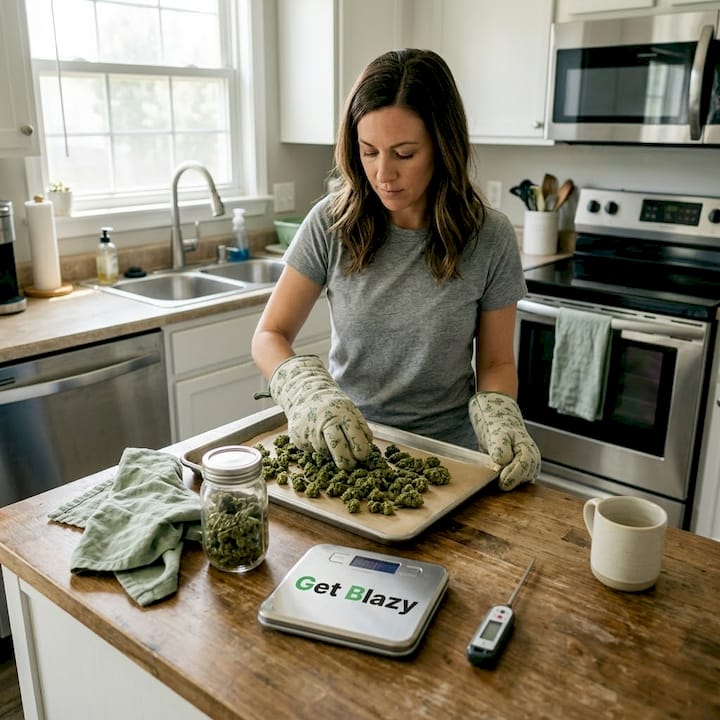
You don’t need a professional setup. Here’s what actually works:
- Oven or countertop toaster oven with reliable temperature control
- Oven thermometer (built-in thermostats are often 10 to 25 degrees off)
- Baking sheet lined with unbleached parchment paper
- Mason jar with a loose-fitting lid (for sealed method)
- Grinder or scissors for breaking down flower evenly
- Kitchen timer with an alarm
- Airtight storage container for finished product
Pro Tip: Buy a standalone oven thermometer from any kitchen supply store. Oven temperature variance is real and it wrecks decarb results. If your oven runs hot, you’ll degrade your cannabinoids faster than you think.
Hemp vs. cannabis flower: a quick comparison
| Feature | CBD Hemp Flower | THCA Flower |
|---|---|---|
| Legal status in FL | Generally compliant | Legally complex post-decarb |
| Primary compound post-decarb | CBD | THC |
| Wellness focus | Relaxation, balance | Relaxation, euphoria |
| Florida compliance risk | Low | High |
| Best for Miami users | Yes | Use with caution |
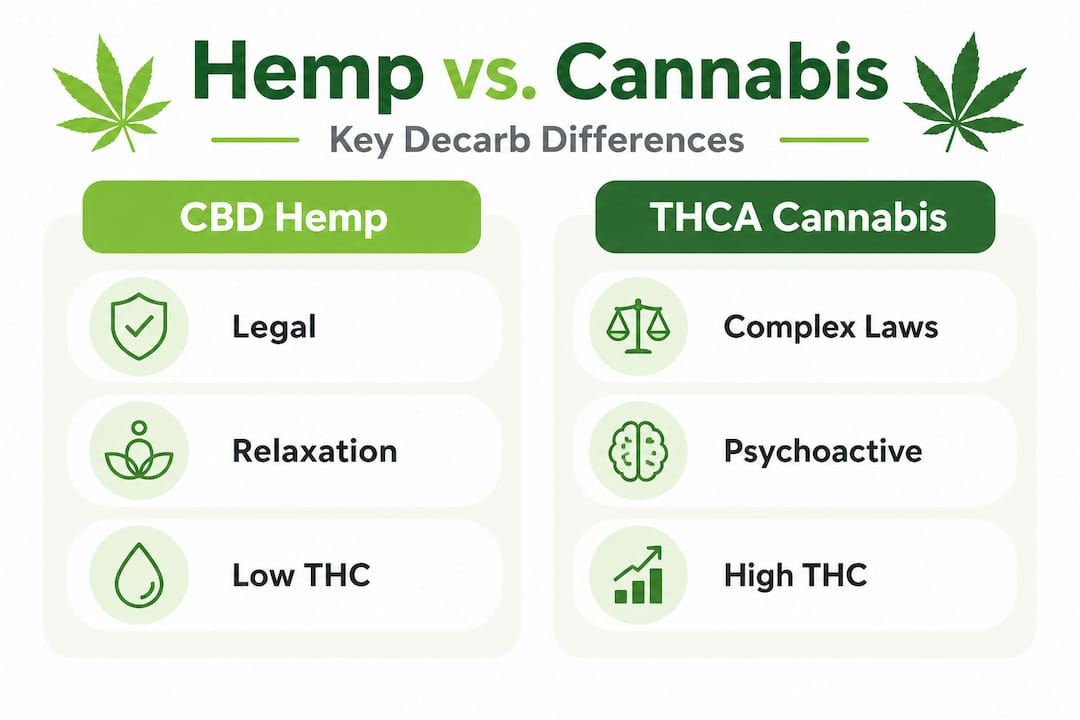
Choosing the right starting material is as important as the method itself. For most Miami wellness users, CBD hemp flower gives you the best combination of effectiveness and peace of mind.
Step-by-step decarboxylation methods
With everything in place, let’s walk through exactly how to decarb your flower. The process is straightforward, but precision matters at every step.
The oven method (most common)
- Preheat your oven to 220°F to 240°F (104°C to 115°C). Use your standalone thermometer to confirm actual temperature.
- Grind your flower to a medium consistency. You want even, consistent pieces, not powder.
- Spread the ground flower in a single, even layer on parchment paper over your baking sheet.
- Place in the oven and set your timer. For THC activation, bake for 30 to 40 minutes. For CBD, extend to 40 to 60 minutes.
- Stir or shake the flower at the halfway point to ensure even heat distribution.
- Monitor color carefully. Your flower should turn from bright green to a golden brown. This color change signals successful decarboxylation.
- Remove and cool completely before storing in an airtight container.
The mason jar method (sealed)
This approach is almost identical to the oven method, except you place your ground flower loosely inside a mason jar, then set the lid on top without sealing it tight. This allows some pressure release while still trapping aromatic compounds. Place the jar directly on the oven rack and follow the same time and temperature guidelines. The sealed environment dramatically reduces the smell that escapes into your kitchen, which is a real advantage for apartment dwellers in Miami.
The sous vide method (advanced)
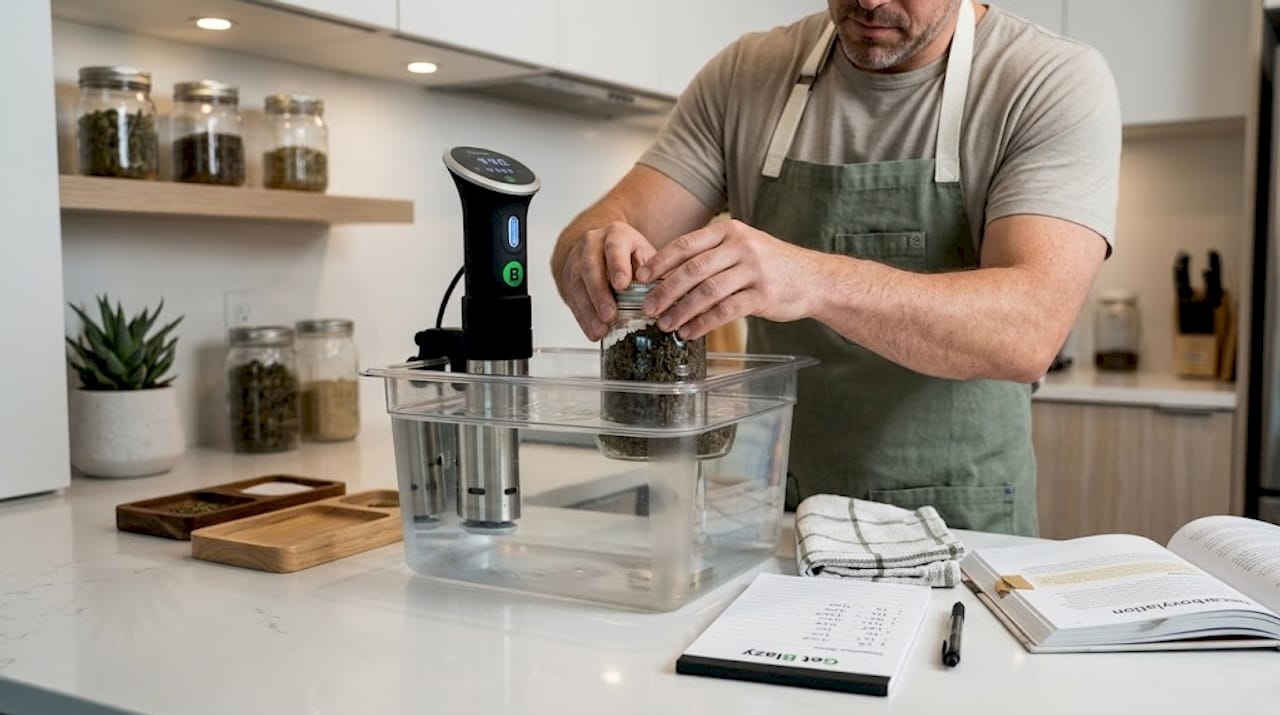
If you have an immersion circulator, sous vide is the gold standard for precision. Set your water bath to 203°F to 212°F (95°C to 100°C), vacuum seal your flower, and submerge for 90 minutes. The consistent, water-regulated temperature eliminates hot spots entirely.
Temperature and time reference table
| Target compound | Temperature | Time | Method |
|---|---|---|---|
| THC (THCA conversion) | 220 to 240°F | 30 to 40 min | Oven or mason jar |
| CBD (CBDA conversion) | 240 to 266°F | 40 to 60 min | Oven or mason jar |
| Precision activation | 203 to 212°F | 90 min | Sous vide |
Research confirms the science behind these numbers. A 2016 conversion study found that THCA achieves 97 to 100% conversion at 110°C over 30 minutes, with the reaction following first-order kinetics. What that means practically: higher temperatures speed up the reaction but also speed up degradation. You’re always balancing activation against loss.
Key insight: The decarb process is not just about getting the compounds active. It’s about doing so without burning off the parts that make your experience pleasant and effective. A few degrees and a few extra minutes can shift the outcome significantly.
Pro Tip: For CBD-dominant hemp flower, don’t rush the time just because the flower looks golden early. CBD requires slightly longer heat exposure than THC for full CBDA conversion. Set your timer and trust the process.
Avoiding mistakes and maximizing effects
After following the main decarb steps, it’s worth taking a hard look at the mistakes that consistently derail people’s results. Some errors waste your flower. Others can actually create legal complications.
The most common decarb mistakes
- Running the oven too hot. Going above 300°F rapidly destroys cannabinoids and terpenes. What you’re left with is harsh, less effective material.
- Skipping the thermometer. Many home ovens are calibrated poorly. Without verification, you’re guessing.
- Grinding too fine. Powder-fine material burns unevenly and can scorch before the inside of each particle activates.
- Not stirring halfway through. The front of the baking sheet runs hotter than the back. Stirring equalizes the exposure.
- Decarbing in open air unnecessarily. The smell is intense and the terpene loss is real.
The legal mistake most people don’t think about
For Miami residents using THCA hemp flower, completing a full decarb changes the legal classification of your product. The Arrhenius kinetics model explains why: the rate of cannabinoid conversion increases exponentially with temperature. At higher temperatures, full conversion happens fast, which means your flower’s legal status shifts quickly too. If Florida’s total THC formula already pushes your raw flower close to the limit, post-decarb material can push it well over. This isn’t hypothetical. It’s the reason staying with CBD-dominant hemp is the smartest choice for compliance-conscious users.
Protecting your terpenes
Terpenes are the aromatic compounds that give each flower its distinct smell and contribute meaningfully to the overall wellness experience. They evaporate at lower temperatures than cannabinoids. Sealed methods like mason jars and sous vide retain 80 to 95% of terpenes compared to only 60 to 75% with open-oven methods. The difference in flavor and sensory quality is noticeable, and for wellness-focused users who care about the full-spectrum effect, that preservation matters.
Pro Tip: If you’re using an open oven method but want to retain more terpenes, reduce your temperature by 10°F and add 5 to 10 minutes to the baking time. Lower and slower is nearly always better for flavor and gentleness.
Signs of a bad decarb
- Dark brown or black color means overheating. The cannabinoids have degraded.
- Unchanged bright green color means underheating. The THCA or CBDA hasn’t converted.
- Harsh, acrid smell during baking means your temperature spiked too high.
- No golden hue at all after full time suggests your oven is running cold. Check your thermometer.
How to verify your results and use decarbed cannabis
Once you avoid those pitfalls, you can confidently assess your finished product and put it to work for your wellness routine.
Visual and tactile checks
The simplest check is visual. Properly decarbed flower should look:
- Golden brown in color, similar to lightly toasted herbs
- Dry and crumbly, not moist or spongy
- Slightly reduced in volume compared to raw flower
- Uniform in color across the batch, no green spots mixed with dark brown
If patches of bright green remain, you likely need another 5 to 10 minutes of heat. If anything is dark brown verging on black, that section is overcooked and you should separate it out.
Home testing limitations
Visual checks give you a reasonable indicator, but they aren’t scientifically precise. Home test kits provide very rough estimates. For anything beyond personal wellness use, you’d want actual lab analysis. Here’s why that matters: GC-MS testing without proper derivatization underestimates total THC and CBD by 40 to 50% due to incomplete decarboxylation in the sample prep process itself, not your flower. So even lab results can be misleading if the test methodology isn’t calibrated for raw versus decarbed material.
Best uses for your activated flower
Once your flower is properly activated, the practical options are excellent:
- Infused oils and butters. Decarbed flower steeped in coconut oil or butter transfers activated CBD or THC into a versatile cooking base.
- Herbal teas. Adding decarbed CBD flower to warm herbal teas with a fat source (like coconut milk) creates a gentle, relaxing drink.
- Edibles. Brownies, cookies, and savory dishes all benefit from infused butter or oil made from activated flower.
- Capsules. Pack finely ground decarbed flower into empty gelatin capsules for a straightforward, measured wellness supplement.
For Miami users prioritizing compliance, the post-activation legal risks of THCA flower are worth repeating here. If your end use is wellness, CBD-dominant flower, decarbed and infused, gets you effective results without crossing any lines Florida has drawn. The wellness benefits of activated CBD, including support for relaxation and balance, are well worth the effort of doing this right.
Miami wellness: What most guides miss about decarbing weed
Here’s the opinion you won’t find in most standard decarb tutorials: the conventional advice is written for a generic national audience, and it doesn’t account for what it means to be a wellness-focused cannabis user in Miami specifically.
Most guides tell you to preheat to 240°F for 30 to 40 minutes and call it done. That works in Colorado or California. In Florida, it can put you in a genuinely complicated legal position if you start with THCA flower. And the science backs this up: going above 130°C risks converting THC to CBN, a less potent compound, while simultaneously pushing your activated THC content into territory that Florida’s formula classifies as non-compliant.
What Miami users who get this right actually do is prioritize CBD activation from CBDA-dominant hemp. They choose sealed methods to protect terpenes. They use lower temperatures and longer times. They treat the process more like slow cooking than speed cooking. And critically, they start with verified, lab-tested hemp flower from compliant sources rather than trying to navigate the ambiguity of gray-market THCA products.
The relaxation and wellness benefits of decarbed CBD flower are real and substantial. You don’t need to push legal boundaries to get there. The smartest approach is to optimize the method, protect the terpenes, activate the CBD fully, and source your starting material from somewhere you can actually trust.
Get wellness-ready cannabis delivered in Miami
If you’ve done the research and understand what goes into a proper decarb, you also know that starting with high-quality, lab-tested flower matters as much as technique. Poor source material produces poor results no matter how careful you are.
At Get Blazy, we stock premium hemp-derived products sourced from reputable manufacturers and tested for purity and Florida compliance. Whether you want CBD flower for decarbing at home, ready-made CBD edibles, tinctures, or vape cartridges, our Biscayne Blvd location and fast Miami delivery have you covered. Skip the guesswork of sourcing and focus on the part you can actually control: the process. Shop in-store or order online and have compliant, wellness-focused products delivered directly to you across Miami.
Frequently asked questions
What temperature is best for decarbing weed for CBD or THC?
For THC activation, use 220 to 240°F for 30 to 40 minutes. For CBD, a slightly higher range around 266°F for 40 to 60 minutes produces optimal CBDA conversion.
Is it legal to decarb hemp flower in Miami?
CBD-dominant hemp flower is generally compliant, but Florida’s total THC formula adds 87.7% of THCA to Delta-9 THC when calculating legal limits, which means THCA flower can exceed those limits after decarboxylation.
How can I tell if my weed is fully decarbed?
Properly decarbed flower turns golden brown and becomes dry and crumbly, but note that GC-MS lab testing without derivatization underestimates cannabinoid levels by 40 to 50%, so visual checks are a guide, not a guarantee.
What are the risks of using high temperatures when decarbing?
Temperatures above 130°C can convert THC to CBN, which is less potent, and can also degrade terpenes rapidly, reducing both the effectiveness and the flavor of your finished product.
Why do sealed methods offer better results for flavor and terpenes?
Sealed methods like mason jar or sous vide create a contained environment that retains 80 to 95% of terpenes, compared to 60 to 75% with open-oven baking, which directly improves flavor, aroma, and the overall wellness experience.