Most Miami residents assume all CBD products sold locally are automatically legal and safe. That assumption can lead to serious compliance issues and health risks. Florida’s hemp regulations underwent major changes in 2025, with additional federal restrictions taking effect in November 2026. These updates impact everything from THC limits and product testing to packaging requirements and age restrictions. Understanding these evolving rules is essential for safe consumption and legal purchases. This guide breaks down Florida’s current CBD framework, helping you navigate the complex regulatory landscape with confidence and make informed choices about hemp-derived wellness products.
Table of Contents
- Florida CBD Laws And Hemp Regulations Overview
- Safety Standards, Testing, And Packaging Requirements For CBD Products
- Legal Purchase And Sales Compliance: Permits, Age Limits, And Licensing In Florida
- Recent Regulatory Updates And Judicial Rulings Affecting Florida Hemp Products
- Explore Compliant CBD Products In Miami With Get Blazy
Key takeaways
| Point | Details |
|---|---|
| THC limits tightened | Florida maintains 0.3% delta-9 THC by dry weight, with new federal cap of 0.4 mg total THC per container effective November 2026. |
| Mandatory safety testing | All hemp products require third-party lab testing with scannable QR codes linking to Certificates of Analysis for batch verification. |
| Child-resistant packaging required | Products must use child-resistant packaging and avoid shapes or colors appealing to minors, with 66 color additives banned or restricted. |
| Age and permit restrictions | Only adults 21+ may purchase CBD, and retailers must hold DACS food establishment permits to sell hemp products legally. |
| Court rulings affirm limits | Florida’s Fifth District Court of Appeals upheld strict total THC concentration limits in 2026, blocking higher-potency products. |
Florida CBD laws and hemp regulations overview
The 2018 Farm Bill legalized hemp federally, defining it as cannabis containing less than 0.3% delta-9 THC by dry weight. Florida adopted this framework while implementing additional state-specific requirements. CBD derived from hemp is legal in Florida when products meet both federal and state THC thresholds and comply with safety standards.
A significant federal change arrived in 2025 when Congress narrowed the hemp definition and imposed a 0.4 mg total THC limit per container, effective November 12, 2026. This restriction applies to all cannabinoids, not just delta-9 THC, fundamentally reshaping product formulations. Florida’s regulatory framework now operates under dual constraints: the state’s 0.3% delta-9 THC by dry weight rule and the incoming federal per-container limit.
Florida legalized hemp under the Farm Bill with regulations managed by the Florida Department of Agriculture and Consumer Services. The state enforces these rules through Florida Administrative Code 5B-57.014 and Florida Statute 581.217. Only adults 21 and older may legally purchase hemp-derived CBD products in Florida, with no exceptions.
Recent 2025 FDACS rule updates significantly strengthened safety, testing, and packaging standards. These changes address longstanding concerns about unregulated products and youth access. The regulatory environment continues evolving rapidly, requiring consumers and businesses to stay informed about compliance requirements.
Key regulatory principles governing Florida CBD include:
- Hemp products must contain less than 0.3% delta-9 THC by dry weight to qualify as legal hemp
- All products require third-party laboratory testing and transparent labeling
- Child-resistant packaging became mandatory in June 2025
- Retailers must hold proper permits and verify customer age before sales
- Products exceeding THC limits fall under medical marijuana laws requiring physician approval
Safety standards, testing, and packaging requirements for CBD products
Florida’s 2025 regulatory overhaul introduced comprehensive safety measures designed to protect consumers and ensure product integrity. All hemp products must come in child-resistant packaging starting June 2025, with labels listing THC percentages, serving sizes, ingredients, batch numbers, and expiration dates. This transparency allows consumers to make informed decisions and verify product authenticity.
Third-party laboratory testing is mandatory for all hemp-derived CBD products sold in Florida. Products must include scannable QR codes or barcodes linking directly to Certificates of Analysis that verify cannabinoid content and screen for contaminants like pesticides, heavy metals, and residual solvents. These COAs provide batch-specific data, ensuring traceability throughout the supply chain.

Packaging restrictions extend beyond child resistance. Florida bans 37 color additives completely and restricts 29 others in hemp products to prevent marketing that appeals to children. Products cannot be shaped like candy, animals, or cartoon characters. These rules apply to all hemp-derived items, including Delta-8 and Delta-10 THC products, not just CBD.
Labeling requirements ensure consumers understand exactly what they’re purchasing. Every package must display:
- Total THC percentage and milligrams per serving
- Complete ingredient list in descending order by weight
- Manufacturer contact information and batch identification number
- Clear expiration or best-by date
- Scannable code linking to third-party lab results
- Warning statements about intoxicating effects if applicable
Pro Tip: Before purchasing any CBD product in Miami, scan the QR code on the package to verify the COA matches the batch number. Legitimate products will have recent test results showing cannabinoid profiles and contaminant screening. If the code doesn’t work or links to generic information, consider it a red flag.
| Safety Requirement | Implementation Date | Purpose |
|---|---|---|
| Child-resistant packaging | June 2025 | Prevent accidental ingestion by minors |
| Third-party lab testing | June 2025 | Verify cannabinoid content and screen contaminants |
| Scannable QR codes | June 2025 | Enable consumer verification of test results |
| Color additive restrictions | June 2025 | Reduce youth appeal through packaging design |
These safety standards create a more transparent marketplace where consumers can confidently evaluate product quality and compliance. Testing requirements cover not only CBD but all cannabinoids present, including Delta-8 THC, Delta-10 THC, and other hemp derivatives that have flooded the market in recent years.
Legal purchase and sales compliance: permits, age limits, and licensing in Florida
Selling hemp-derived CBD products in Florida requires proper licensing and strict adherence to age verification protocols. Hemp product sales require businesses to hold DACS food establishment permits as of 2026. This requirement eliminated the previous gray area where convenience stores and gas stations sold hemp products without appropriate oversight.
CBD and hemp products may only be sold to adults 21 or older with no exceptions. Retailers must verify age through government-issued identification before completing any transaction. This applies to both in-store purchases and online orders with delivery. Businesses failing to comply face penalties including permit revocation and potential criminal charges.
The regulatory framework creates a clear distinction between legal hemp products and medical marijuana. Products exceeding 0.3% delta-9 THC fall under Florida’s medical marijuana program, requiring patients to obtain physician approval and enroll in the state’s medical marijuana registry. These higher-THC products cannot be sold through standard retail channels, even to adults 21 and older.
Compliance requirements for Florida hemp retailers include:
- Obtaining and maintaining current DACS food establishment permits
- Verifying customer age for every hemp product transaction
- Ensuring all inventory meets state THC limits and testing requirements
- Maintaining records of product sourcing and batch information
- Training staff on regulatory requirements and age verification procedures
Pro Tip: When shopping for CBD in Miami, purchase only from licensed retailers who can provide proof of their DACS permit. Legitimate businesses will display their permit prominently and have knowledgeable staff who understand current regulations. Avoid purchasing from unlicensed vendors or informal sellers who cannot verify product compliance.
| Product Category | THC Limit | Age Requirement | Sales Authorization |
|---|---|---|---|
| Hemp-derived CBD | Below 0.3% delta-9 THC | 21+ | DACS food permit required |
| Medical marijuana | Above 0.3% delta-9 THC | 18+ with physician approval | State medical marijuana license |
| Federal hemp (Nov 2026) | 0.4 mg total THC per container | 21+ | DACS food permit required |
These distinctions matter significantly for both consumers and retailers. The tightened federal limit taking effect in November 2026 will likely remove many current products from the market, as formulations exceeding 0.4 mg total THC per container will no longer qualify as legal hemp. Businesses must reformulate products or transition them to medical marijuana channels.
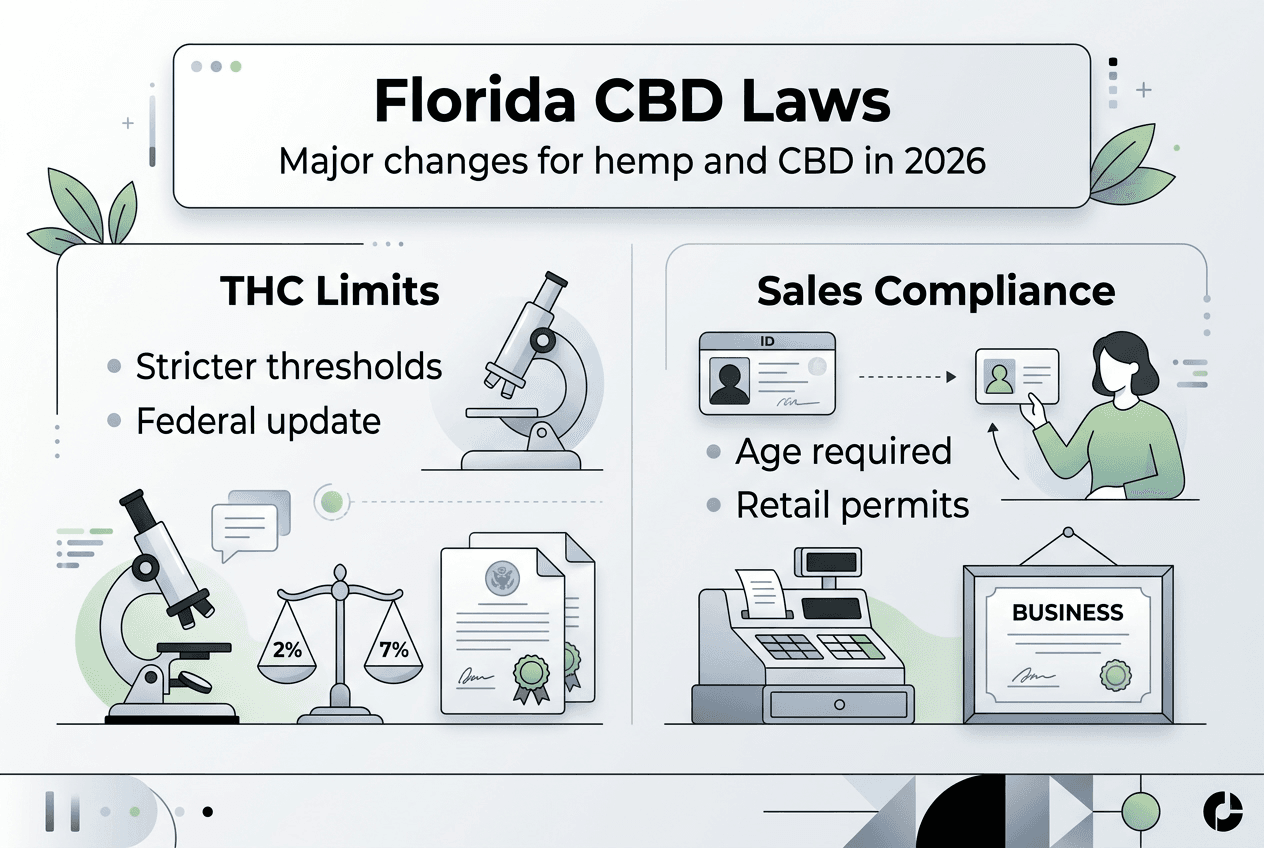
Recent regulatory updates and judicial rulings affecting Florida hemp products
Florida’s hemp regulatory landscape underwent dramatic transformation in 2025 and early 2026. Florida finalized two major FDACS rule updates in 2025 enhancing food safety standards, mandatory testing protocols, and restrictions preventing youth access. These rules closed loopholes that allowed unregulated products to flood the market.
A landmark court decision in 2026 clarified the state’s regulatory authority. Florida’s Fifth District Court of Appeals upheld the state’s strict total THC limits for hemp products, affirming FDACS’s power to enforce concentration restrictions beyond just delta-9 THC. This ruling prevents introduction of higher-potency intoxicating hemp products under existing law, maintaining Florida’s conservative approach to hemp regulation.
The court’s decision came after industry challenges arguing Florida’s rules were overly restrictive compared to federal standards. The ruling definitively establishes that states may impose stricter requirements than federal minimums, giving FDACS clear authority to regulate total cannabinoid content rather than focusing solely on delta-9 THC.
Key regulatory milestones shaping Florida’s 2026 hemp landscape:
- June 2025: Child-resistant packaging and enhanced labeling requirements take effect statewide
- September 2025: FDACS finalizes comprehensive testing protocols for all cannabinoids
- January 2026: Court ruling upholds Florida’s authority to enforce total THC concentration limits
- November 2026: Federal 0.4 mg total THC per container limit becomes enforceable
- Ongoing: FDACS continues developing additional safety and marketing restriction rules
These changes reflect a broader trend toward stricter oversight of hemp-derived intoxicating products. Florida’s approach prioritizes consumer safety and youth protection over industry expansion, contrasting sharply with more permissive states.
“This decision affirms our commitment to protecting Florida consumers, especially young people, from unregulated intoxicating substances marketed as hemp products. We will continue enforcing science-based standards that prioritize public health.” — Florida Agriculture Commissioner Wilton Simpson on the 2026 court ruling
Consumers and businesses must recognize that regulatory evolution continues. Additional rule changes are likely as federal agencies clarify hemp definitions and states respond to emerging products. Staying informed through official FDACS channels and reputable industry sources is essential for maintaining compliance and making safe purchasing decisions.
Explore compliant CBD products in Miami with Get Blazy
Navigating Florida’s complex CBD regulations becomes simpler when you shop with trusted, compliance-focused retailers. Get Blazy offers a carefully curated selection of hemp-derived CBD products that meet all Florida legal requirements for THC content, testing, and packaging. Every product comes with accessible third-party lab results, giving you confidence in what you’re purchasing.
Located on Biscayne Blvd, Get Blazy serves Miami residents with both in-store shopping and convenient online ordering with discreet delivery. Our selection includes CBD tinctures, gummies, vape products, oils, and topicals from reputable manufacturers who prioritize transparency and quality. All products feature child-resistant packaging and clear labeling with scannable QR codes linking to current Certificates of Analysis.
Shopping with Get Blazy means working with knowledgeable staff who understand Florida’s regulatory requirements and can guide you toward products that align with your wellness goals while ensuring full legal compliance. We verify age for all purchases and maintain the proper DACS permits required for hemp product sales.
FAQ
What are Florida’s legal limits for THC in hemp products?
Legal hemp in Florida must contain less than 0.3% delta-9 THC by dry weight to comply with state law. Products exceeding this threshold are classified as marijuana and fall under Florida’s medical marijuana program, requiring physician approval and patient registry enrollment. Starting November 2026, federal law also caps total THC at 0.4 mg per container, creating dual compliance requirements for manufacturers and retailers.
How can I verify a CBD product’s safety and authenticity in Florida?
Look for scannable QR codes or barcodes linking to third-party Certificates of Analysis when purchasing CBD products. These COAs should display batch-specific test results showing cannabinoid content and contaminant screening. Check labels for batch numbers, expiration dates, complete ingredient lists, and THC percentages. Legitimate products will have recent test results from accredited laboratories, and the batch number on the package should match the COA.
Do Miami local laws restrict CBD products beyond state regulations?
Local Miami ordinances may impose additional restrictions on CBD product sales and consumption beyond Florida state regulations. While state law provides the baseline framework, municipalities can add requirements regarding business licensing, zoning for retailers, and public consumption restrictions. Consumers and sellers should verify current Miami city ordinances to ensure full compliance with both state and local requirements before purchasing or operating a hemp business.
What age do I need to be to legally buy CBD products in Florida?
Florida requires purchasers of hemp-derived CBD products to be at least 21 years old with absolutely no exceptions. Retailers must verify age through government-issued identification before completing any sale, whether in-store or online with delivery. This age restriction applies to all hemp products, including CBD oils, edibles, vapes, and topicals. Businesses selling to underage customers face serious penalties including permit revocation and potential criminal charges.